Born: 12 August 1862 in Blet, Cher, France
Died: 14 October 1956 in Châteauroux, Indre, France
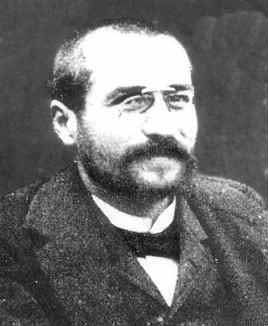
Jules Richard taught at lycées in Tours, Dijon and Châteauroux. He obtained a doctorate on the surface of Fresnel waves from the Faculty of Science in Paris in 1901. He defended his thesis in an examination held on 22 November 1901. Notice that by this time he was 39 years old.
Jules Richard wrote on the philosophy of mathematics in 1903 publishing Sur une manière d'exposer la géométrie projective in that year. This paper discussed axiomatic projective geometry and built on work by Hilbert, von Staudt and Méray. Then in 1908 Richard wrote Sur la nature des axiomes de la géométriein which he looked critically at four different approaches to geometry:-
- Geometry is founded on arbitrarily chosen axioms - there are infinitely many equally true geometries.
- Experience provides the axioms of geometry, the basis is experimental, the development deductive.
- The axioms of geometry are definitions. Notice this is logically quite different from (i).
- Axioms are neither experimental nor arbitrary, they force themselves on us since without them experience is not possible. This approach was essentially that proposed by Kant.
Having given these four separate approaches, Richard then proceeds to point out unacceptable aspects of each of the four. He then goes on to make his own suggestion as to how to approach geometry. He writes (see for example [1]):-
Axioms are propositions, the task of which is to make precise the notion of identity of two objects pre-existing in our mind.
But of course, writes Richard, there is an ultimate goal which must be kept in mind when approaching geometry:-
To explain the material universe is the goal of science.
Richard was thinking about geometry at a time when the non-euclidean geometries had been discovered. He writes:-
One sees that having admitted the notion of angle, one is free to choose the notion of straight line in such a way that one or another of the three geometries is true.
Jules Richard is remembered mainly, however, for Richard's paradox involving the set of real numbers which can be defined in a finite number of words. The paradox first appeared in a letter from Richard to Louis Olivier, the director of Revue générale des sciences pures et appliquées. Basically the paradox comes about from the fact that the real numbers are uncountable, yet one can only ever describe countably many real numbers using the English language. (Actually, of course, Richard used French but since we are writing this biography in English, we will have to explain the paradox in English.) Examples of English descriptions or real numbers are "one third", "the base of natural logs", and "the ratio of the circumference of a circle to its diameter", etc. Richard then created a list of all real numbers which could be described in English. (It is easy to do this - just order the descriptions in terms of the length of the sentence describing the real number and within sentences of the same length use lexicographic order.) Using Cantor's diagonal argument, he then constructed a real number which could not be described in English. But of course this number has just been described in English! The paradox appears in Les Principes des mathématiques et le problème des ensembles (1905).
If Richard's paradox tells us anything then perhaps it is a warning not to use English (or any other language for that matter) when we are doing mathematics.
- in Dictionary of Scientific Biography (New York 1970-1990).
http://www.encyclopedia.com/doc/1G2-2830903657.html








