Born: 17 December 1835 in Pavia, Italy
Died: 11 September 1890 in Casteggio, Italy
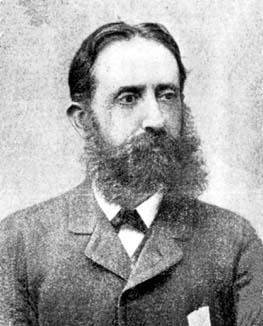
Felice Casorati's parents were Francesco Casorati and Maria Stabilini. Francesco Casorati was a medical man who researched in physiology at the University of Pavia. Felice was a student at Pavia and initially his interests were in engineering and architecture. He received a diploma in these subjects from Pavia in 1856. After this he began to help A Bordoni and Brioschi but very quickly was acting as their assistant. He was appointed as a teaching assistant at Pavia in 1875, teaching topography and hydrometry. In 1858, together with Betti and Brioschi, he visited Göttingen, Berlin and Paris and this visit is often taken as the point where Italian mathematics joined the mainstream of European mathematics. On this and later journeys, for example he discussed the foundations of analysis with Kronecker and Weierstrass. While in Germany in 1864, Casorati became familiar with he ideas of Riemann and Weierstrass on complex function theory and then spread these ideas through his lectures and contacts.
After returning from the first of his journeys in 1859, Casorati was appointed as extraordinary professor of algebra and analytic geometry at the University of Pavia. In 1862 he was appointed as an ordinary professor at Pavia and in the following year he succeeded Mainardi to the chair of infinitesimal calculus. He taught geodesy and analysis at Pavia from 1865 to 1868 when he moved to Milan where he taught until 1875, although he continued to hold the chair at Pavia. Leaving Milan he returned to Pavia in 1875 where he taught analysis until his death.
Casorati wrote one major book and published 49 research papers. Differential equations were of great interest to him and his research in this area was undertaken with the aim of making the existing theories more accurate and more complete. He also worked on complex function theory, and wrote an important book Teoria delle funzioni di variabili complesse (1868) on this topic. Particularly pleasing to those with an interest in the history of mathematics is the fact that in the first part of the text he gives a valuable historical account of the development of the theory. Other areas to which he made major contributions include the inversion of abelian integrals and the existence of many-valued functions with an infinity of distinct periods.
Casorati is best remembered for the Casorati- Weierstrass theorem which says that an analytic function comes arbitrarily close to any given value in any neighbourhood of an essential singularity. Weierstrass proved this in a paper of 1876 and, although he had proved it some time before publication, Casorati had already included it in his 1868 treatise Teoria delle funzioni di variabili complesse. The paper [9] contains a careful analysis which shows convincingly that, although Weierstrass and Casorati were in correspondence, it was Casorati who gave the first proof. In fact the first to make an investigation relevant to this problem was Liouville who began the attempt to characterize analytic functions in terms of their singularities and to investigate spherical representation. Although Neuenschwander shows that priority rests with Casorati, nevertheless Weierstrass did prove a lemma in 1841 which was needed by Casorati in his proof.
Casorati was an energetic correspondent and much still survives that gives an inside picture of the scientific and academic life in Italian universities in the second half of the 19th century. For example he corresponded with Beltrami between the years 1862 and 1889 are discussed in [8], and the 27 letters between Hermite and Casorati from 1863 to 1889 on various mathematical topics are discussed in [4]. He corresponded with Weierstrass, who told him in a letter written in 1867 that Italian scientific investigations were better understood and valued in Germany than in England and France, and also that German mathematics was more appreciated in Italy than in either France or England. There is an interesting comment by Bottazzini in [5] that provides some understanding of why this might have come about. He notes that since both Germany and Italy were at the time struggling towards political unification, mathematicians from these countries would necessarily have had a common bond.
Struik, writing about Neuenschwander's research on Casorati's papers which are held in Pavia [10], lists some more of Casorati's correspondents:-
Casorati left a large number of papers, now preserved in Pavia. They contain hundreds of letters to mathematicians, memoranda on conversations, observations on contemporary papers, a diary, some lecture notes and manuscripts, including much of considerable interest to the student of the mathematics of the mid- and late nineteenth century. Among the mathematicians with whom Casorati corresponded we find Eneström, Fuchs, Hermite, Kronecker, Schwarz, Prym, Mittag-Leffler and Schläfli (no fewer than 108 letters with him). Conversations with Kronecker and Weierstrass are reported. ... Casorati, in these papers, is seen clearly as one of the principal figures in the transmission of German and French mathematics to the new generation of Italian mathematicians such as Betti, Beltrami and others.
Casorati received many honours. He was elected to the Göttingen Academy of Sciences (Königliche Gesellschaft der Wissenschaften) in 1877, the Turin Mathematical Society (by then the Turin Academy of Sciences) in 1880, the Bologna Academy of Sciences in 1885, and the Berlin Academy of Sciences in 1886. He was also elected to the Lombardy Institute of Sciences and Letters in 1868, the Italian Society of Science in 1869, and the Accademia dei Lincei in 1875 (having been a corresponding member from 1871).
Books:
- F Casorati, Opere (2 vols.), A cura dell'Unione Matematica Italiana (Edizioni Cremonese della Casa Editrice Perrella, Roma, 1951).
- S Cinquini and F Gherardelli, In memoria di Felice Casorati (1890-1990) (Cisalpino - Istituto Editoriale Universitario S.r.l., Milan, 1992).
Articles:
- U Bottazzini, Riemanns Einfluss auf E Betti und F Casorati, Arch. History Exact Sci. 18 (1) (1977/78), 27-37.
- U Bottazzini, Multiply-periodic functions in the correspondence between Hermite and Casorati (Italian), Archive for History of Exact Science 18 (1) (1977/78), 39-88.
- U Bottazzini, The influence of Weierstrass's analytical methods in Italy, in Amphora (Birkhäuser, Basel, 1992), 67-90.
- K-R Biermann, Die Wahlvorschläge für Betti, Brioschi, Beltrami, Casorati und Cremona zu Korrespondierenden Mitgliedern der Berliner Akademie der Wissenschaften, Boll. Storia Sci. Mat. 3 (1) (1983), 127-136.
- S Cinquini, The golden decade of Pavian mathematics (1880-90) and its reprise at the beginning of the next century (Italian), in Faiths and cultures in the Padua area in the late nineteenth and the early twentieth century, Pavia, 1991, Ann. Storia Pavese (22-23) (1995), 439-458.
- A Gabba, More of the letters of Felice Casorati: his correspondence with Eugenio Beltrami (Italian), Istit. Lombardo Accad. Sci. Lett. Rend. A 136/137 (2002/03), 7-48.
- E Neuenschwander, Studies in the history of complex function theory. I: The Casorati- Weierstrass theorem, Historia Mathematica 5 (2) (1978), 139-166.
- E Neuenschwander, Der Nachlass von Casorati (1835-1890) in Pavia, Archive for History of Exact Science 19 (1) (1978/79), 1-89.








