Instrument performance checks
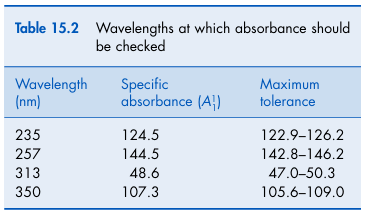
Wavelength The wavelength scale must be verified using the absorption maxima of holmium perchlorate solution, the lines of a hydrogen or deuterium discharge lamp, or the lines of a mercury vapour lamp. The permitted tolerance is 1 nm for the UV range and 3 nm for the visible range. Absorbance The absorbance should be checked using suit able filters or a solution of potassium dichromate of 60 mg/L in 0.005 M sulfuric acid at the wavelengths indicated in Table 15.2.
Stray light the level of stray light should be assessed, since it increases with instrument age. It may be detected at a given wavelength with suitable filters or a 1.2% w/v potassium chloride solution. The European Pharmacopeia (Council of Europe 2008) requires that the absorbance be greater than 2 at a wavelength of 198 nm when compared with water as compensation liquid.
Resolution In some assays it is necessary to specify the minimum desirable resolution, since changes in the spectral bandwidth (or monochromator slit-width) can seriously affect the observed absorbance of sharp peaks. The European Pharmacopoeia (Council of Europe 2008) requires that the spectral bandwidth employed should be such that further reduction does not lead to an increase in measured absorbance. This is particularly important for drugs that have aromatic or strongly conjugated systems (e.g. diphenhydramine, phenoxymethylpenicillin, and amphotericin A and B). In such cases, a spectral bandwidth of more than 1 nm leads to a reduction in observed absorbance at the peak maximum (and conversely an increase in absorbance at a peak minimum), since the recorded absorbance is the mean of that over the whole bandwidth at that wavelength. Although increasing the slit width gives a better signal-to-noise ratio, a slit width of 2 nm is adequate for most bands, with 1 nm or 0.5 nm being used for very sharp peaks. For qualitative analysis the resolution can be measured by recording the spectrum of a 0.02% solution of toluene in hexane. The minimum ratio of the absorbance at the maximum at 269 nm to that at the minimum at 266 nm is stated in the monographs of the European Pharmacopoeia (Council of Europe 2008).
Good laboratory practice According to the principles of good laboratory practice (GLP), the apparatus should be periodically inspected, cleaned, maintained and calibrated according to the laboratory’s Standard Operating Procedures. Records of procedures should be maintained. Calibration should, where appropriate, be traceable to national or international standards of measurements. Instrument manufacturers are now integrating GLP into their instruments. Examples of this include a logbook database in which lamp changes and defects are registered. Also, a key lock function is now a common part of a quality system to avoid effects from unwanted keystrokes.








