0
EN
1
المرجع الالكتروني للمعلوماتية

Grammar

Tenses

Present

Present Simple

Present Continuous

Present Perfect

Present Perfect Continuous

Past

Past Simple

Past Continuous

Past Perfect

Past Perfect Continuous

Future

Future Simple

Future Continuous

Future Perfect

Future Perfect Continuous

Parts Of Speech

Nouns

Countable and uncountable nouns

Verbal nouns

Singular and Plural nouns

Proper nouns

Nouns gender

Nouns definition

Concrete nouns

Abstract nouns

Common nouns

Collective nouns

Definition Of Nouns

Animate and Inanimate nouns

Nouns

Verbs

Stative and dynamic verbs

Finite and nonfinite verbs

To be verbs

Transitive and intransitive verbs

Auxiliary verbs

Modal verbs

Regular and irregular verbs

Action verbs

Verbs

Adverbs

Relative adverbs

Interrogative adverbs

Adverbs of time

Adverbs of place

Adverbs of reason

Adverbs of quantity

Adverbs of manner

Adverbs of frequency

Adverbs of affirmation

Adverbs

Adjectives

Quantitative adjective

Proper adjective

Possessive adjective

Numeral adjective

Interrogative adjective

Distributive adjective

Descriptive adjective

Demonstrative adjective

Pronouns

Subject pronoun

Relative pronoun

Reflexive pronoun

Reciprocal pronoun

Possessive pronoun

Personal pronoun

Interrogative pronoun

Indefinite pronoun

Emphatic pronoun

Distributive pronoun

Demonstrative pronoun

Pronouns

Pre Position

Preposition by function

Time preposition

Reason preposition

Possession preposition

Place preposition

Phrases preposition

Origin preposition

Measure preposition

Direction preposition

Contrast preposition

Agent preposition

Preposition by construction

Simple preposition

Phrase preposition

Double preposition

Compound preposition

prepositions

Conjunctions

Subordinating conjunction

Correlative conjunction

Coordinating conjunction

Conjunctive adverbs

conjunctions

Interjections

Express calling interjection

Phrases

Sentences

Clauses

Part of Speech

Grammar Rules

Passive and Active

Preference

Requests and offers

wishes

Be used to

Some and any

Could have done

Describing people

Giving advices

Possession

Comparative and superlative

Giving Reason

Making Suggestions

Apologizing

Forming questions

Since and for

Directions

Obligation

Adverbials

invitation

Articles

Imaginary condition

Zero conditional

First conditional

Second conditional

Third conditional

Reported speech

Demonstratives

Determiners

Direct and Indirect speech

Linguistics

Phonetics

Phonology

Linguistics fields

Syntax

Morphology

Semantics

pragmatics

History

Writing

Grammar

Phonetics and Phonology

Semiotics

Reading Comprehension

Elementary

Intermediate

Advanced

Teaching Methods

Teaching Strategies

Assessment

قم بتسجيل الدخول اولاً لكي يتسنى لك الاعجاب والتعليق.

PREPOSITIONS AND THE PREPOSITIONAL PHRASE (PP) INTERNAL STRUCTURE OF THE PREPOSITIONAL PHRASE (PP)

المؤلف:  Angela Downing

المصدر:  ENGLISH GRAMMAR A UNIVERSITY COURSE

الجزء والصفحة:  P467-C12

2026-07-13

27

+

-

20

PREPOSITIONS AND THE PREPOSITIONAL PHRASE (PP)

INTERNAL STRUCTURE OF THE PREPOSITIONAL PHRASE (PP)

A notable feature of the English language is the extremely wide use it makes of prepositions; and where there is a preposition there is a PP, since prepositions cannot normally stand alone, although they can be separated from their complement by ‘stranding’.


The structure of the prepositional phrase is different from that of groups. While nouns, adjectives and adverbs each function as head of their respective group and can be used alone, a preposition cannot normally occur without a nominal unit, and a nominal unit is not part of a PP if there is no preposition. Both are equally necessary to form the phrase. For this reason we refer to such a unit as a prepositional phrase.


The internal structure of a PP consists of a preposition and its complement, both of which are obligatory, and an optional modifier. It can be represented as follows:
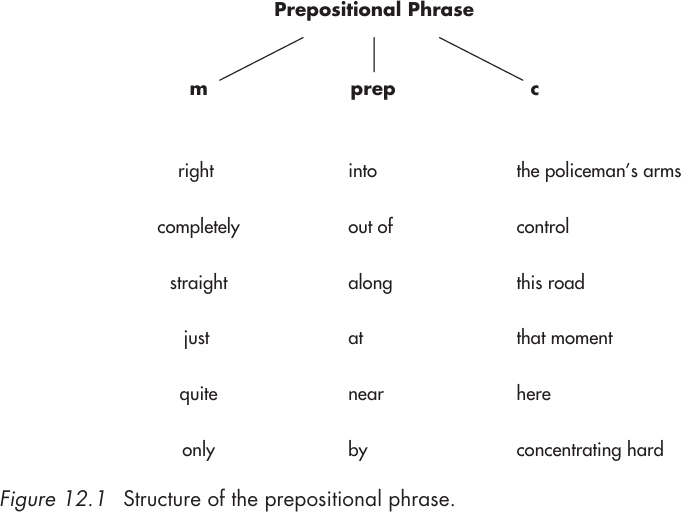
 

Not all PPs contain a modifier but all of them contain a preposition and a complement. The modifier typically intensifies the preposition by adding something specific to its meaning, such as exactness in the case of straight (straight along this road) or exclusiveness with only (only by concentrating hard).


Here is a recorded conversation between three students and a teacher (T), which illustrates the abundant use of prepositional phrases in English:

T: What’s this about?1

B: Oh, animals.

T: Oh, yes. People are obsessed in this country2 with being kind3 to animals,4 aren’t they?

A: Alison and her cat . . .!

B: Don’t talk to us5 about Alison’s cat!6

C: That cat is definitely not popular in our house!7

B: That cat moults constantly all over our carpet and sofa!8

T: But is it true, though? See what I mean? She hates cats! A: Just for that silly reason?9

T: No, but there seem to be more cases of animal cruelty10 going on here than anywhere else.11

A: Yeah. I get the impression from the little I know12 they’re just as crazy about dogs13 in Belgium and Holland and France and Italy14 as they are over here.15

T: Is it just one of those myths that we perpetuate regarding the British character?16 Is it true?

A: I think it probably is a myth.

                                                                                                                          (recorded conversation)

اخر الاخبار

اشترك بقناتنا على التلجرام ليصلك كل ما هو جديد


