Negation of the modals must and may
Negation of the modal verbs must and may is complex because either the modal concept (in the ‘a’ examples) or the lexical concept (in the ‘b’ examples) can be negated.
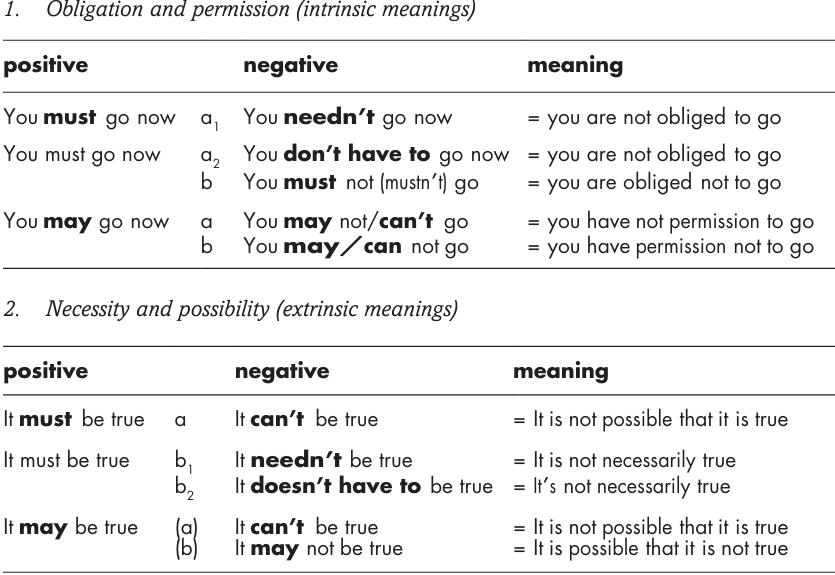
When might and could express possibility, they negate in the same way as may, with replacement by can’t for modal negation and not to negate the lexical verb.
Need not (needn’t) is often replaced by the objective form doesn’t/don’t have to in both kinds of modal meaning, the epistemic and the deontic. Have to is also used by many speakers in the interrogative: Do you have to go now? for Need you go now?, especially in the meaning of obligation. Questioning is less common with meanings of possibility and necessity, for example: Does it have to be true?
Mustn’t is usually reserved for the obligation meaning of must, for example, We mustn’t forget to ask Sue to water the plants (= obligation not to forget).
May in its meaning of permission does not have a full set of unambiguous forms: you may not go serves for both modal and lexical negation. The meaning ‘you have permission not to go’ can be conveyed by stressing the negative particle not – You may not go, if you like.
Can and can’t have replaced may/may not in the expression of permission except in the most formal contexts.
Can’t, needn’t and don’t have to negate and question the modal concept. When the lexical concept is negated, this is achieved by not, which can be attached as n’t to must (mayn’t is not normally used).
Can’t is the usual form used to negate must (necessity) and may (possibility).








