LEXICAL ASPECT OF ENGLISH VERBS
Before examining the second grammatical aspect available to speakers of English, the Progressive, we turn for a moment to lexical aspect. All verbs (and predicates) have an inherent lexical aspect. We have touched on this concept in outlining the stative vs dynamic distinction, verbal groups and the behavior of particles in phrasal verbs.
Lexical aspect proves to be an invaluable tool for understanding the functioning of the Progressive and the Perfect aspects. In fact, it is not easy to grasp the contribution made by the grammatical aspects without realizing how they interact with the lexical aspect of the verb. In taking a little further the stative–dynamic distinction, we will now be considering whole situations to which the verb brings its own inherent aspectuality, in terms of two factors:
• temporal boundaries: whether the situation is bounded (i.e. has an end-point) or unbounded (has no end-point)
• duration or non-duration (through time)
The diagram illustrates the main situation types.
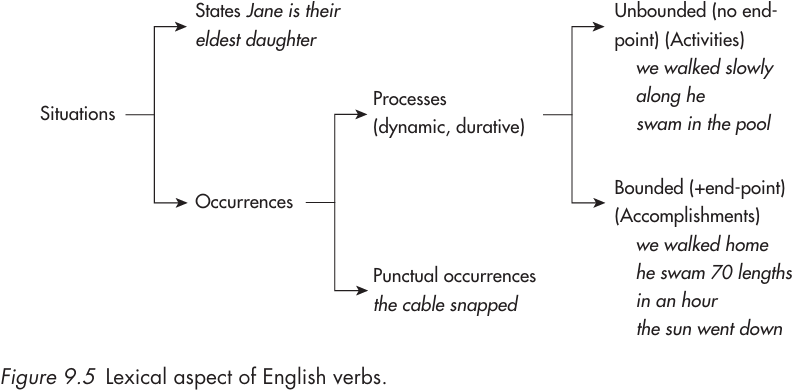
Reading from left to right in the diagram, situations can be classified as follows:
1 States vs Occurrences. States have relatively long duration but do not have boundaries: they are unbounded, as with verbs such as be, stand (The house stands on a hill). Occurrences are dynamic and more complex. They are subdivided according to duration into:
2 Processes vs punctual occurrences. Processes are durative, they last through time, while punctual occurrences occupy little or no appreciable time and have sharp boundaries, e.g. the cable snapped.
(Note that ‘process’ is used here differently from its use as a general term for the semantic structure of clauses)
3 Durative processes are divided into those that have no end-point (unbounded Activities), as in He walked slowly along, and those that have a sharp end-point (bounded Accomplishments), as in he walked home. The latter consist of two phases, a durative phase, the walking, and a terminative phase, the arrival home. The durative phase is usually not in focus unless combined with progressiveness.
Note that although the traditional terms, Activities and Accomplishments, suggest human agency, it is not the case that all processes are agentive. It rained heavily, for instance, is a non-agentive activity. The key concept here is boundedness, that is, whether or not there is an end-point.
The way in which a situation is viewed can be modified in various ways:
• By adding an adjunct or an adverbial particle such as up, which establishes an endpoint: In this way an unbounded situation can be made bounded. Compare:
unbounded process bounded process
It rained heavily. It rained heavily until six o’clock.
The children have grown in your absence. The children have grown up in your absence.
• By including a multiple subject or object instead of a single element, a situation is presented as repeated or ‘serial’. This effect can also be achieved by adjuncts.
He rang his agent last week. They rang their agents every day last week.
• By grammatical aspect, which we deal with next.
Verbs corresponding to each of the four groups include:
Stative verbs: be, belong, seem, stand, lie, have, want, know, understand, see, hear, feel, like, dislike, hate, love.
Punctual or momentary verbs: cough, blink, flash, hit, tap, slam, slap, kick, shoot.
Unbounded-process verbs: bend, dance, drive, read, sleep, write, walk, work.
Bounded-completion verbs: be born, die, fall, drop, arrive, sit down, stand up.








