Grammar
Tenses
Present

Present Simple
Present Continuous
Present Perfect
Present Perfect Continuous
Past
Past Simple
Past Continuous
Past Perfect
Past Perfect Continuous
Future
Future Simple
Future Continuous
Future Perfect
Future Perfect Continuous
Parts Of Speech
Nouns
Countable and uncountable nouns
Verbal nouns
Singular and Plural nouns
Proper nouns
Nouns gender
Nouns definition
Concrete nouns
Abstract nouns
Common nouns
Collective nouns
Definition Of Nouns
Animate and Inanimate nouns
Nouns
Verbs
Stative and dynamic verbs
Finite and nonfinite verbs
To be verbs
Transitive and intransitive verbs
Auxiliary verbs
Modal verbs
Regular and irregular verbs
Action verbs
Verbs
Adverbs
Relative adverbs
Interrogative adverbs
Adverbs of time
Adverbs of place
Adverbs of reason
Adverbs of quantity
Adverbs of manner
Adverbs of frequency
Adverbs of affirmation
Adverbs
Adjectives
Quantitative adjective
Proper adjective
Possessive adjective
Numeral adjective
Interrogative adjective
Distributive adjective
Descriptive adjective
Demonstrative adjective
Pronouns
Subject pronoun
Relative pronoun
Reflexive pronoun
Reciprocal pronoun
Possessive pronoun
Personal pronoun
Interrogative pronoun
Indefinite pronoun
Emphatic pronoun
Distributive pronoun
Demonstrative pronoun
Pronouns
Pre Position
Preposition by function
Time preposition
Reason preposition
Possession preposition
Place preposition
Phrases preposition
Origin preposition
Measure preposition
Direction preposition
Contrast preposition
Agent preposition
Preposition by construction
Simple preposition
Phrase preposition
Double preposition
Compound preposition
prepositions
Conjunctions
Subordinating conjunction
Correlative conjunction
Coordinating conjunction
Conjunctive adverbs
conjunctions
Interjections
Express calling interjection
Phrases
Sentences
Grammar Rules
Passive and Active
Preference
Requests and offers
wishes
Be used to
Some and any
Could have done
Describing people
Giving advices
Possession
Comparative and superlative
Giving Reason
Making Suggestions
Apologizing
Forming questions
Since and for
Directions
Obligation
Adverbials
invitation
Articles
Imaginary condition
Zero conditional
First conditional
Second conditional
Third conditional
Reported speech
Demonstratives
Determiners
Linguistics
Phonetics
Phonology
Linguistics fields
Syntax
Morphology
Semantics
pragmatics
History
Writing
Grammar
Phonetics and Phonology
Semiotics
Reading Comprehension
Elementary
Intermediate
Advanced
Teaching Methods
Teaching Strategies
Assessment

The interactive function of language
 المؤلف:
Vyvyan Evans and Melanie Green
المؤلف:
Vyvyan Evans and Melanie Green
 المصدر:
Cognitive Linguistics an Introduction
المصدر:
Cognitive Linguistics an Introduction
 الجزء والصفحة:
C1P9
الجزء والصفحة:
C1P9
 2025-11-22
 269
269




+
-
20
The interactive function of language
In our everyday social encounters, language serves an interactive function. It is not sufficient that language merely pairs forms and meanings. These form meaning pairings must be recognised by, and be accessible to, others in our community. After all, we use language in order to ‘get our ideas across’, in other words to communicate. This involves a process of transmission by the speaker, and decoding and interpretation by the hearer, processes that involve the construction of rich conceptualisations (see Figure 1.4).
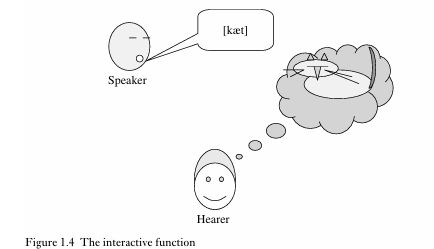
The messages we choose to communicate can perform various interactive and social functions. For example, we can use language to change the way the world is, or to make things happen:

The utterance in (2a), spoken by a suitably qualified person (such as a member of the clergy licensed to perform marriages), in an appropriate setting (like a church), in the presence of two unmarried adults who consent to be joined in matrimony, has the effect of irrevocably altering the social, legal and even spiritual relationship between the two people. That is, language itself can serve as a speech act that forever alters an aspect of our reality.
Similarly, in the example in (2b), the utterance represents a command, which is also a type of speech act. Language provides a means of communication, allowing us to share our wishes and desires. Moreover, the way in which these wishes and desires are expressed signals who we are, and what kind of relationship we have with our addressee. We would be unlikely to issue a command like (2b) to the Queen of England, for example.
Another way in which language fulfils the interactive function relates to the notion of expressivity. Language is ‘loaded’, allowing us to express our thoughts and feelings about the world; consider the different mental images evoked by the following expressions, which might be used by different speakers to refer to the same individual:
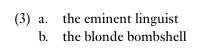
While the example in (3a) focuses on the profession of the individual and her relative standing in that profession, the example in (3b) focuses on her physical appearance. Moreover, although both these sentences relate to a female linguist, the person’s gender cannot be inferred from the sentence in (3a) while it can from the second sentence due to normative patterns of linguistic behaviour and social stereoptypes. That is, we typically use the expression blonde bomb shell to describe the physical attributes of women rather than men.
Language also plays a role in how we affect other people in the world, and how we make others feel by our choice of words. That is, language can provide information about affect (emotional response):

These examples also illustrate the way in which we present our public selves through language. The language we choose to use conveys information about our attitudes concerning others, ourselves and the situations in which we find ourselves.
Language can be used to create scenes or frames of experience, indexing and even constructing a particular context (Fillmore 1982). In other words, language use can invoke frames that summon rich knowledge structures, which serve to call up and fill in background knowledge.
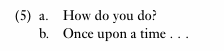
The example in (5a) creates a greeting frame, signalling an acknowledgement of another person and a recognition that this is the first time they have met. It also signals a degree of formality, which expressions like hey, what’s up? or hi would not. Analogously, the utterance in (5b) signals the beginning of a fairy tale. In other words, just by hearing or reading the expression in (5b) an entire frame is invoked, which guides how we should respond to what follows, what our expectations should be and so forth.
In summary, we’ve seen that not only does language encode particular meanings, but also that, by virtue of these meanings and the forms employed to symbolise these meanings which constitute part of shared knowledge in a particular speech community, language can serve an interactive function, facilitating and enriching communication in a number of ways.
 الاكثر قراءة في Linguistics fields
 اخر الاخبار
اخبار العتبة العباسية المقدسة

الآخبار الصحية


مواضيع ذات صلة
 قسم الشؤون الفكرية يصدر كتاباً يوثق تاريخ السدانة في العتبة العباسية المقدسة
 "المهمة".. إصدار قصصي يوثّق القصص الفائزة في مسابقة فتوى الدفاع المقدسة للقصة القصيرة
 (نوافذ).. إصدار أدبي يوثق القصص الفائزة في مسابقة الإمام العسكري (عليه السلام)