Levels of stress
Up to this point we have talked about stress as though there were a simple distinction between "stressed" and "unstressed" syllables with no intermediate levels; such a treatment would be a two-level analysis of stress. Usually, however, we have to recognize one or more intermediate levels. It should be remembered that we are dealing only with stress within the word. This means that we are looking at words as they are said in isolation, which is a rather artificial situation: we do not often say words in isolation, except for a few such as 'yes', 'no', 'possibly', 'please' and interrogative words such as 'what', 'who', etc. However, looking at words in isolation does help us to see stress placement and stress levels more clearly than studying them in the context of continuous speech.
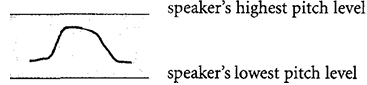
Let us begin by looking at the word 'around' ə'raʊnd, where the stress always falls clearly on the last syllable and the first syllable is weak. From the point of view of stress, the most important fact about the way we pronounce this word is that on the second syllable the pitch of the voice does not remain level, but usually falls from a higher to a lower pitch. We can diagram the pitch movement as shown below, where the two parallel lines represent the speaker's highest and lowest pitch level. The prominence that results from this pitch movement, or tone, gives the strongest type of stress; this is called primary stress.
In some words, we can observe a type of stress that is weaker than primary stress but stronger than that of the first syllable of 'around'; for example, consider the first syllables of the words 'photographic' fəʊtəræfɪk, 'anthropology' ænθrəpɒlədƷi. The stress in these words is called secondary stress. It is usually represented in transcription with a low mark (ו) so that the examples could be transcribed as וfəʊtə'græfɪk, ænθrə'pɒlədƷi.
We have now identified two levels of stress: primary and secondary; this also implies a third level which can be called unstressed and is regarded as being the absence of any recognizable amount of prominence. These are the three levels that we will use in describing English stress. However, it is worth noting that unstressed syllables containing ə, ɪ, i, u, or a syllabic consonant, will sound less prominent than an unstressed syllable containing some other vowel. For example, the first syllable of 'poetic' pəʊ'etɪk is more prominent than the first syllable of 'pathetic' pə'θetɪk. This could be used as a basis for a further division of stress levels, giving us a third ("tertiary") level. It is also possible to suggest a tertiary level of stress in some polysyllabic words. To take an example, it has been suggested that the word 'indivisibility' shows four different levels: the syllable bIl is the strongest (carrying primary stress), the initial syllable In has secondary stress, while the third syllable vɪz has a level of stress which is weaker than those two but stronger than the second, fourth, sixth and seventh syllable (which are all unstressed). Using the symbol to mark this tertiary stress, the word could be represented like this: וmdɪ₀vɪzə'bɪləti. While this may be a phonetically correct account of some pronunciations, the introduction of tertiary stress seems to introduce an unnecessary degree of complexity. We will transcribe the word as וɪndɪוvɪzə'bɪləti.








