Factors contributing to variation
As mentioned above, the GhE vowel system is characterized by a lot of inter- and intra-individual variation. One source of the latter may be advanced tongue root (ATR) vowel harmony, which is found in a number of Ghanaian languages including Ahanta and the Akan group in the south, and Dagaare and Kasem in the north. The vowels of these languages can be grouped in two sets, advanced and unadvanced, as illustrated here for Akan:

As a general rule, only vowels of one set occur in polysyllabic words. Some speakers carry ATR vowel harmony over to English, so that the advanced and unadvanced members of the two sets become free variants in GhE:  , [e- ε],
  , etc. This accounts for a lot of the vowel height variation observable in GhE and explains pronunciations like agencies
 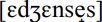 instead of the expected [eʤεnsis]. It may also account for some unexpected vowels: it was said above that RP /i:/ and /ɪ/ merge to /i/ in GhE, so that we would expect three [tri] and six [siks]. Instead, many Ghanaians realize these words as [tre] and [sεks], respectively, thereby maintaining the /i - ɪ/ opposition in RP by replacing the tense-lax opposition by an advanced-unadvanced vowel pair. RP /ɪ/ > GhE /ε/ is the more frequent substitution, found in the pronunciation of e.g. it, killed, people, or things.
Another area of variability is vowel nasalization. Nasalization is distinctive in many Ghanaian languages and there is a strong tendency for GhE speakers to nasalize vowels before /n/ (much less so before the other nasals). In many cases this is accompanied by the reduction (indicated by a superscript n ) or complete loss of /n/, so that we find the following pronunciations of twenty and nine:

In some cases, the loss of final /-n/ leads to near-homophony of pairs like can – car, been – bee, coffin – coffee, etc. These words are then only distinguished by the presence or absence of nasalization in the final vowel:  . As far as such pairs are concerned, nasalization could be said to be distinctive in GhE. However, since individual speakers use full, reduced, and elided forms side by side
  , it appears that the nasal is part of the underlying phonological representation of such words and that its reduction or loss are surface co-articulation effects.
Vowel ellipsis in polysyllabic words is rather common in Ghanaian Radio and TV English, even more so than in BrE: forms like police [plis], necessary [nεsεsri], operational [ɔpreiʃnal], etc. have some currency in the spoken media but also among very acrolectal or language-aware speakers.
On the phonetic level, GhE syllable-initial vowels, especially those at the beginning of words, are characterized by glottal reinforcement [?V], e.g. hour [?aua], all [?ɔl], auditorium [?ɔditɔriɔm], office [?ɔfis], east [?ist]. Other than in BrE, glottal reinforcement does not signal special emphasis but is an intrinsic, sub-phonemic property of vowels in initial positions.








