

Grammar


Tenses


Present

Present Simple

Present Continuous

Present Perfect

Present Perfect Continuous


Past

Past Simple

Past Continuous

Past Perfect

Past Perfect Continuous


Future

Future Simple

Future Continuous

Future Perfect

Future Perfect Continuous


Parts Of Speech


Nouns

Countable and uncountable nouns

Verbal nouns

Singular and Plural nouns

Proper nouns

Nouns gender

Nouns definition

Concrete nouns

Abstract nouns

Common nouns

Collective nouns

Definition Of Nouns

Animate and Inanimate nouns

Nouns


Verbs

Stative and dynamic verbs

Finite and nonfinite verbs

To be verbs

Transitive and intransitive verbs

Auxiliary verbs

Modal verbs

Regular and irregular verbs

Action verbs

Verbs


Adverbs

Relative adverbs

Interrogative adverbs

Adverbs of time

Adverbs of place

Adverbs of reason

Adverbs of quantity

Adverbs of manner

Adverbs of frequency

Adverbs of affirmation

Adverbs


Adjectives

Quantitative adjective

Proper adjective

Possessive adjective

Numeral adjective

Interrogative adjective

Distributive adjective

Descriptive adjective

Demonstrative adjective


Pronouns

Subject pronoun

Relative pronoun

Reflexive pronoun

Reciprocal pronoun

Possessive pronoun

Personal pronoun

Interrogative pronoun

Indefinite pronoun

Emphatic pronoun

Distributive pronoun

Demonstrative pronoun

Pronouns


Pre Position


Preposition by function

Time preposition

Reason preposition

Possession preposition

Place preposition

Phrases preposition

Origin preposition

Measure preposition

Direction preposition

Contrast preposition

Agent preposition


Preposition by construction

Simple preposition

Phrase preposition

Double preposition

Compound preposition

prepositions


Conjunctions

Subordinating conjunction

Correlative conjunction

Coordinating conjunction

Conjunctive adverbs

conjunctions


Interjections

Express calling interjection

Phrases

Sentences


Grammar Rules

Passive and Active

Preference

Requests and offers

wishes

Be used to

Some and any

Could have done

Describing people

Giving advices

Possession

Comparative and superlative

Giving Reason

Making Suggestions

Apologizing

Forming questions

Since and for

Directions

Obligation

Adverbials

invitation

Articles

Imaginary condition

Zero conditional

First conditional

Second conditional

Third conditional

Reported speech

Demonstratives

Determiners


Linguistics

Phonetics

Phonology

Linguistics fields

Syntax

Morphology

Semantics

pragmatics

History

Writing

Grammar

Phonetics and Phonology

Semiotics


Reading Comprehension

Elementary

Intermediate

Advanced


Teaching Methods

Teaching Strategies

Assessment
Consonants
المؤلف:
Ulrike B. Gut
المصدر:
A Handbook Of Varieties Of English Phonology
الجزء والصفحة:
822-45
2024-05-08
1475
Consonants
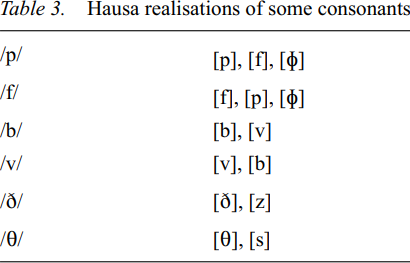
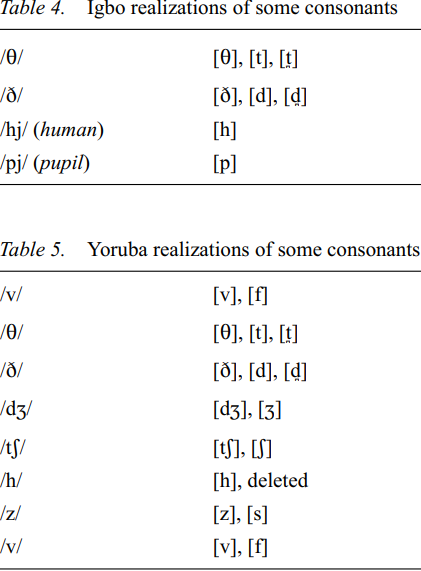
NigE is non-rhotic. The consonant system of NigE shows a lack of the postalveolar fricative /Ʒ/ and the velar nasal /ŋ/, which only exist in the speech of very sophisticated speakers with speech training (Jibril 1986). The consonant phonemes vary in their realizations between Hausa English, Yoruba English and Igbo English as illustrated in Tables 3 to 5 (cf. Jibril 1986; Jowitt 1991).
One general feature of NigE is the (probable) spelling pronunciation of many words. This applies to words ending in orthographic -mb, -ng and those with –st and –bt as in

and also (possibly) to a number of loan words such as

Equally, since orthography suggests it, final –ed is often realized as [d] as for example in increased. This in turn will trigger prevoicing of the consonant preceding the –ed so that the pronunciation is [inkrizd]. Voicing of [ks] can be observed in maximum [magzimçm] and laxity [lagziti], which has been described as an influence from American English (Görlach [1997]).
On the other hand, devoicing of final consonants is common in NigE (Simo Bobda 1997), as for example in with, which is often realized as [wiθ], robe, which is realized as [rop] and leave, which is realized as [lif]. Similarily, the plural /–z/ and third person singular /-z/ is often replaced by [-s] as in roads [rɔds] , doors [dɔs] and digs [dɪgs] (Jibril [1986]).
There are two simplification strategies for consonant clusters in NigE. One is the reduction of word-final consonant clusters by deletion of the last part as in
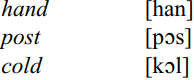
The consonant cluster /kw/ is reduced to [k] as in [εkɪpmεn(t)] for equipment. Quantitative support for this comes from an experimental study involving ‘reading passage’ style (Gut 2003). I found that syllable structures that never occur in NigE speech compared to British English speech are syllables with deleted vowels (C, CC, CCC), syllables with three consonants in the onset position (CCCV, CCCVC, CCCVVC), the syllable type VVC and syllables with three consonants in the coda position (CVCCC). Furthermore, Nigerians produce significantly more open syllables (syllables without a final consonant) than British English speakers reading the same passage, which reflects the high proportion of consonant deletions.
The other consonant cluster simplification strategy is the insertion of the epenthetic vowel [u] or [i] between word-final syllabic consonants and the preceding consonant as e.g. in
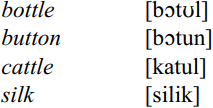
Epenthetic vowels are especially common in Hausa English.
Other phonological processes occurring in NigE include metathesis as in the pronunciation [aks] for ask and, especially in Hausa English, a tendency to gemination as in [gΛmmənt] for government (Jowitt 1991).
الاكثر قراءة في Phonology
اخر الاخبار
اخبار العتبة العباسية المقدسة
الآخبار الصحية

قسم الشؤون الفكرية يصدر كتاباً يوثق تاريخ السدانة في العتبة العباسية المقدسة
"المهمة".. إصدار قصصي يوثّق القصص الفائزة في مسابقة فتوى الدفاع المقدسة للقصة القصيرة
(نوافذ).. إصدار أدبي يوثق القصص الفائزة في مسابقة الإمام العسكري (عليه السلام)


