Influence of other languages
We have already mentioned that many words from Hawaiian came into Hawai‘i Creole through Pidgin Hawaiian and Pidgin English. But the structure of Hawaiian has also affected the structure of Hawai‘i Creole, making it different from that of English. One example is word order. In Hawaiian, there are sentences such as Nui ka hale. Literally this is ‘Big the house’, which in English would be ‘The house is big’. Similarly, in Hawai‘i Creole we find sentences such as Big, da house and Cute, da baby.
Other languages also appear to have influenced the structure of Hawai‘i Creole more than the vocabulary. One such language is Cantonese. For example, in Cantonese one word yáuh is used for both possessive and existential sentences, i.e. meaning both ‘have/has’ and ‘there is/are’, as in these examples below (from Matthews and Yip 1994):
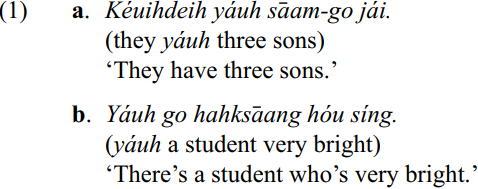
Similarly, in Hawai‘i Creole one word get is used for both possessive and existential, as in (2):

Portuguese appears to have affected the structure of Hawai‘i Creole even more. For instance, Portuguese uses the word para meaning ‘for’ to introduce infinitival clauses, where Standard English uses to, as in (3):

Similarly, for (or fo) is used in Hawai‘i Creole:

The Portuguese copula/auxiliary estar (with various conjugations such as está) has several different functions, including copula with locations and adjectives, auxiliary for present progressive, and marker for perfective, as in the examples in (5):
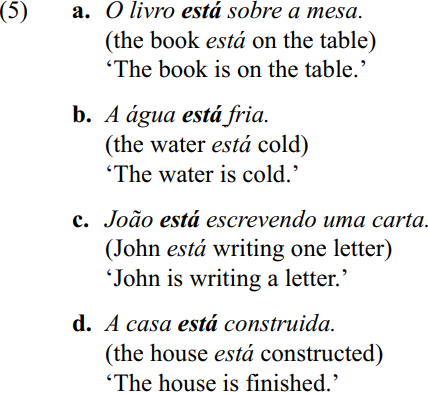
In Hawai‘i Creole, the word stay has the same functions:

The phonology of Hawai‘i Creole also has some similarities to that of Hawaiian, Cantonese and Portuguese, especially in the vowel system and intonation in questions, but these connections have not been studied in any detail.
Thus, the ethnic groups whose languages most influenced the structure of Hawai‘i Creole seem to have been the Hawaiians, Chinese and Portuguese. But the influence of the Hawaiians declined steadily as their numbers declined and the numbers of other ethnic groups increased. By 1900, there were more Portuguese and Chinese than Hawaiians and Part-Hawaiians. Even though the Japanese were by far the largest immigrant group, their language seems to have had little effect on the structure of Hawai‘i Creole. One reason for this was first pointed out by the famous Hawai‘i Creole scholar, John Reinecke, who wrote (1969: 93): “The first large immigration of Japanese did not occur until 1888 when the Hawaiian, Chinese and Portuguese between them had pretty well fixed the form of the ‘pidgin’ [English] spoken on the plantations.”
Another reason is that, as we have seen, it was the locally born members of immigrant groups who first used Pidgin English as their primary language and whose mother tongues influenced the structure of the language. This structure was then passed on to their children in the development of Hawai‘i Creole. When the creole first began to emerge, the locally born population was dominated by the Chinese and Portuguese. Of these two groups, the Portuguese were the more important. In 1896, they made up over half of the locally born immigrant population. For the Portuguese, the number of locally born came to equal the number of foreign born in 1900, whereas this did not happen for the Chinese until just before 1920 and for the Japanese not until later in the 1920s.
The Portuguese were also the most significant immigrant group in the schools. They were the first group to bring their families, and their demands for education for their children in English rather than Hawaiian were partially responsible for the increase in English-medium public schools. From the critical years of 1881 until 1905, Portuguese children were the largest immigrant group in the schools, with over 20 percent from 1890 to 1905.
Another factor was that the Portuguese, being white, were given a disproportionate number of influential positions on the plantations as skilled laborers, clerks and lunas ‘foremen’ who gave orders to other laborers. In fact, the number of Portuguese lunas was three times larger than that of any other group.
The Portuguese community was also the first to shift from their traditional language to Hawai‘i Creole. By the late 1920s, the Portuguese had the lowest level of traditional language maintenance, and the greatest dominance of English or Hawai‘i Creole in the homes, followed by the Hawaiians and then the Chinese.
But that is not to say that Japanese has had no influence on Hawai‘i Creole. Many Japanese words have come into the language, and several Hawai‘i Creole expressions, such as chicken skin ‘goose bumps’, are direct translations of Japanese. Also, the way many discourse particles are used, such as yeah and no at the end of a sentence, seems to be due to Japanese influence. Furthermore, the structure of narratives in Hawai‘i Creole is very similar to that of Japanese.








