Vowel characteristics
Variation between [æ] and [a:]
The clearest example of a regional difference which is stereotyped (known to many non-linguists) is in the BATH vowel class. For most lexical items in Australian English of all regional and social varieties, the distribution of the earlier TRAP vowel between the modern PALM and TRAP vowels generally follows the southeastern British pattern: mainly PALM before /f, s, θ/, variable before nasal plus obstruent – more so in Australia than in England – and mainly TRAP elsewhere. As is well-known, there are exceptions both ways in southeastern British English and in Australian English, such as gas with TRAP and the second syllable of banana with PALM, and some forms such as plastic and the prefix trans- still vary in Britain.
However, for about sixty morphemes which are now mainly invariant PALM in southeastern British English, especially preceding a nasal + obstruent, but also a smaller number of prefricative words such as castle, graph, and so on, there is regional and social variation in Australia between TRAP and PALM vowels. This clearly distinguishes Australian English from New Zealand English, which has a much stronger tendency to follow the more recent British distribution maximizing the number of former TRAP words now pronounced with PALM.
The current Australian regional distribution appears to reflect the historical and social characteristics of settlement, and allows the chronology of this change within southeastern British English to be traced indirectly, as suggested in Bradley (1991): places settled by the early nineteenth century, and primarily by people of lower socio-economic status, use more PALM as in Sydney, Hobart and Brisbane. Melbourne, settled in the mid-nineteenth century, with a more mixed population, shows a higher proportion of TRAP. Adelaide, settled later in the nineteenth century primarily by people of middle or higher socio-economic status, uses the highest proportion of PALM, and shows a more advanced stage of the shift before nasal + obstruent than elsewhere in Australia, though not quite as far advanced as New Zealand or modern southeastern British English. This implies that the change in southeastern England was underway during the settlement of Australia, and that PALM was a lower-status form in the late eighteenth and early nineteenth century, but had reversed its social value and become a high status form by the late nineteenth century. Furthermore, the change in the nasal + obstruent environment must have followed the prefricative environment by quite some time.
Tables 1 and 2 (from Bradley 1991: 229–230) show the overall regional distribution of words which vary across four major cities, and the difference between the two phonological environments: the earlier environment, before anterior fricatives, and the later environment, before nasal + obstruent.
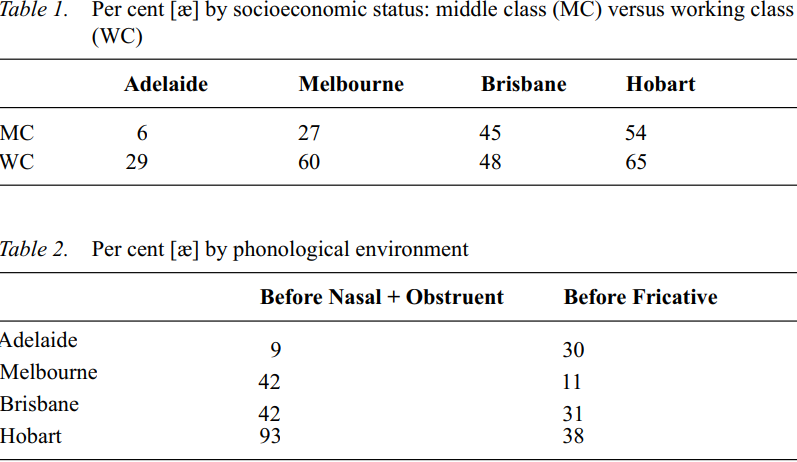
Table 1 shows a status difference which is substantial everywhere except Brisbane: the PALM form is used more by those of higher status. There is also a parallel stylistic difference, not shown in the tables: the proportion of PALM increases as style becomes more formal. Table 2 shows how the more recent environment is less likely to have the PALM form, except in Adelaide where the pattern shows an interesting reversal. Table 3 (from Bradley 1991: 230, with supplementary information on Sydney from Horvath and Horvath 2001a: 350) shows the distribution of the alternatives in seven frequent words. The striking differences show that the lexical diffusion of PALM in this word class is proceeding differently in each part of Australia.

Many Australian non-linguists can cite regional differences in place names containing castle, such as Newcastle or Castlereagh Street in New South Wales (with the PALM vowel) and Castlemaine in Victoria (with the TRAP vowel), or other words which vary, such as dance. Apart from the regional pattern, there is an overlying social pattern in which the PALM vowel is the more formal or high sociolect form, especially for words with nasal + obstruent. So, for example, the first word in the title and last line of the chorus of the national anthem, Advance Australia Fair, is variable but much more likely to have the PALM vowel than the word advance in other contexts, and may do so even in places or sociolects which do not normally have PALM in this or similar words.
In areas where the TRAP vowel is usual for a word, its pronunciation with the PALM vowel is regarded as an affectation; so in Sydney dance is usually as in TRAP, and with the PALM vowel it is regarded there as a British form, or an affected pronunciation. Sometimes this is attributed, inaccurately, to the “other” – by Sydney speakers, who actually use the TRAP vowel more frequently in most words, to “posh” Melburnians, who actually use less PALM than Sydney speakers, and so on. Of the people interviewed in our regional sociolinguistic survey, some in every state and nine per cent overall were aware of this variation, and in all cases they attributed the PALM form to somewhere else. Many Australians have quite strong negative feelings about PALM in these words, which also reflects an increasing departure from the former RP-as-superposed-prestige-norm situation. Conversely, there is also some style shift towards PALM: when something happens in Castlemaine in central Victoria, locally always TRAP, and is mentioned by a Melbourne newsreader of the Australian Broadcasting Corporation, the mainly high-sociolect national government network, it can then have the PALM vowel.
Also involved in the action here is the FACE vowel, a third alternative for many variable words as in other varieties of English as well. While tomato has the PALM and not the FACE vowel and potato is always FACE and never PALM in Australian English, there are many words such as basic which vary between FACE (in most places) and TRAP (mainly in Queensland). Others vary between FACE and PALM, and there are even a few words such as data and lambaste which can have FACE, TRAP or PALM. Again, quite a few of these are regionally distributed, like cicada which has PALM in Sydney and FACE in Melbourne.








