The vocalization of /l/
Among consonant changes perhaps one of the most interesting is the vocalization of /l/ (e.g. Borowsky 2001; Horvath and Horvath 2001, 2002). The vocalized variant of /l/ has the sound of a back vowel [u] and may or may not be rounded or labialized. Although /l/ vocalization occurs in many dialects of English, the reported occurrence of a vocalized /l/ in intervocalic position found in some American dialects is not found in AusE; however, /l/ vocalization in London English does appear to be comparable to AusE. Borowsky (2001) gives an account of the phonological processes involved in vocalization. She begins with an articulatory description of English /l/ as given by Sproat and Fujimura (1993). According to their account, /l/ is bigestural since it has both a tongue tip (coronal) gesture and a tongue body gesture (dorsal). It is the timing of the dorsal gesture in relation to the apical gesture that accounts for the allophonic distribution of dark l and light l in English and that timing depends on where in the syllable the /l/ occurs. Each gesture has a strong affinity for different parts of the syllable (Sproat and Fujimura 1993: 291). The tongue body gesture is inherently vocalic and has an affinity for the syllable nucleus and the tongue tip gesture is inherently consonantal and has an affinity for the syllable onset. Dark l is produced when the /l/ is in the nucleus or near the nucleus because the tongue body gesture precedes the tongue tip gesture; light l is produced when /l/ is the onset of a syllable since the tongue tip gesture precedes. A quantitative study of AusE speakers indicated that syllable type was indeed important to the understanding of the vocalization of /l/. An important finding was that vocalized /l/ never occurred in onset position, whether initially in a word, intervocalically or pre-vocalically. Three syllable types were found to promote vocalization of /l/: coda cluster (milk), syllabic (pickle) and coda (fool/fill). Coda /l/ was further analyzed into those syllables containing a long vowel (fool), in which the /l/ tends to be syllabic, and those containing a short vowel, where the /l/ is just a coda consonant and does not get the extra promotion effect of being in a nuclear position. The comparison of the occurrence of a vocalized /l/ in the four environments is given in Table 4.
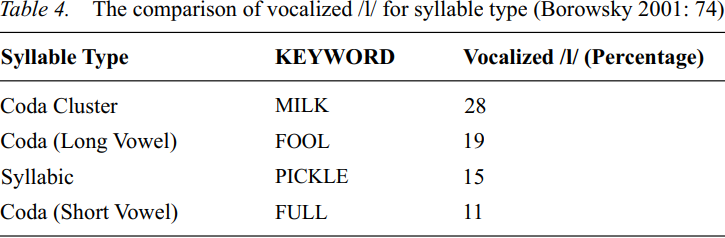
Three other conditioning factors have an effect on the occurrence of a vocalized /l/: (i) the place of articulation of a preceding or following consonant, (ii) whether the following environment is a consonant, a vowel or a pause, and (iii) the backness of the preceding vowel. For both coda clusters and syllabic /l/, the preceding or following segment is a primary factor in vocalization. The vocalization of /l/ is most likely when a dorsal consonant follows, next most likely when a labial consonant follows and least likely when a coronal consonant follows the /l/. It is interesting to note that this process is paralleled in the history of English. In the early Modern English period [l] was lost between some vowels and a following labial or dorsal: talk, half, balm, and folk, and [lt] and [ld] are the only clusters that still occur after these vowels: halt, bolt, fold (Borowsky 2001: 75). When the effect of the place of articulation of a preceding consonant is considered, dorsals clearly enhance the likelihood of vocalization.
A following word beginning with a consonant has the strongest effect in promoting vocalization for all coda /l/ syllables, and a following pause weakly promotes vocalization. A following vowel, however, strongly inhibits vocalization because the /l/ becomes a syllable onset, where, as we have seen, the consonantal gesture is most likely. The effect of a following vowel for syllabic /l/ on the vocalization process is interesting because it does not have the strong effect that a following vowel has for coda /l/. Borowsky (2001: 82–83) explains that the differences occur because when an /l/ is followed by a vowel-initial word, a final /l/ becomes ambisyllabic and provides an onset for the following vowel. A syllabic /l/, however, functions as the nucleus of its own syllable as well as as the onset of the following one. Thus a conflict arises for syllabic /l/ in prevocalic environments that does not occur for coda /l/.
The place of the preceding vowel for clustered /l/ and coda /l/ also affects the occurrence of vocalization. In both syllable types, vocalization is more likely following a central or back vowel and is inhibited following a front vowel. Vowel height also plays an important role in the vocalization of /l/. A preceding high vowel promotes vocalization for both syllable types and while mid vowels disfavor vocalization, low vowels strongly inhibit the process. In fact for clustered /l/, as noted above, the process of /l/ vocalization which began in Early Modern English after low back vowels in such words as palm and calm has resulted in the loss of /l/ in those contexts.
The study of AusE vocalization of /l/ has shown that the process is promoted by backness – adjacent backness of both consonants and vowels in combination with syllable position.








