

Grammar


Tenses


Present

Present Simple

Present Continuous

Present Perfect

Present Perfect Continuous


Past

Past Simple

Past Continuous

Past Perfect

Past Perfect Continuous


Future

Future Simple

Future Continuous

Future Perfect

Future Perfect Continuous


Parts Of Speech


Nouns

Countable and uncountable nouns

Verbal nouns

Singular and Plural nouns

Proper nouns

Nouns gender

Nouns definition

Concrete nouns

Abstract nouns

Common nouns

Collective nouns

Definition Of Nouns

Animate and Inanimate nouns

Nouns


Verbs

Stative and dynamic verbs

Finite and nonfinite verbs

To be verbs

Transitive and intransitive verbs

Auxiliary verbs

Modal verbs

Regular and irregular verbs

Action verbs

Verbs


Adverbs

Relative adverbs

Interrogative adverbs

Adverbs of time

Adverbs of place

Adverbs of reason

Adverbs of quantity

Adverbs of manner

Adverbs of frequency

Adverbs of affirmation

Adverbs


Adjectives

Quantitative adjective

Proper adjective

Possessive adjective

Numeral adjective

Interrogative adjective

Distributive adjective

Descriptive adjective

Demonstrative adjective


Pronouns

Subject pronoun

Relative pronoun

Reflexive pronoun

Reciprocal pronoun

Possessive pronoun

Personal pronoun

Interrogative pronoun

Indefinite pronoun

Emphatic pronoun

Distributive pronoun

Demonstrative pronoun

Pronouns


Pre Position


Preposition by function

Time preposition

Reason preposition

Possession preposition

Place preposition

Phrases preposition

Origin preposition

Measure preposition

Direction preposition

Contrast preposition

Agent preposition


Preposition by construction

Simple preposition

Phrase preposition

Double preposition

Compound preposition

prepositions


Conjunctions

Subordinating conjunction

Correlative conjunction

Coordinating conjunction

Conjunctive adverbs

conjunctions


Interjections

Express calling interjection

Phrases

Sentences


Grammar Rules

Passive and Active

Preference

Requests and offers

wishes

Be used to

Some and any

Could have done

Describing people

Giving advices

Possession

Comparative and superlative

Giving Reason

Making Suggestions

Apologizing

Forming questions

Since and for

Directions

Obligation

Adverbials

invitation

Articles

Imaginary condition

Zero conditional

First conditional

Second conditional

Third conditional

Reported speech

Demonstratives

Determiners


Linguistics

Phonetics

Phonology

Linguistics fields

Syntax

Morphology

Semantics

pragmatics

History

Writing

Grammar

Phonetics and Phonology

Semiotics


Reading Comprehension

Elementary

Intermediate

Advanced


Teaching Methods

Teaching Strategies

Assessment
Tone preservation
المؤلف:
David Odden
المصدر:
Introducing Phonology
الجزء والصفحة:
290-9
12-4-2022
1887
Tone preservation
One very common property exhibited by tones is stability, where the deletion of a vowel does not result in the deletion of the tone borne by the vowel. Very commonly the tone of a deleted vowel is transferred to the neighboring vowel, often resulting in a contour tone. We have seen an example of this phenomenon in Yekhee, where the combination of an L vowel plus H vowel results in a rising-toned vowel, and H+L gives a falling-toned vowel.

In the autosegmental theory, deletion of a vowel does not directly affect the tone which was associated with it, and as a result, after deletion of the vowel the tone simply remains on the tonal tier with no association with the segmental tier – such an unassociated tone is referred to as a floating tone.

One of the principles proposed in this theory is that all vowels must (eventually) bear some tone, and all tones must be borne by some vowel – this condition is known as the Well-formedness Condition. Accordingly the unassociated tones which resulted from the deletion of a vowel would then be associated with the following vowel, resulting in a falling or rising tone.
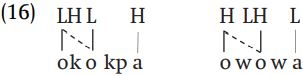
The combination of two like-toned vowels, as in the case of èké élà ! èkélà ‘three rams,’ brings out another principle of the theory. By the operation of vowel deletion and reassociation of the floating tone, one would expect the following representation.
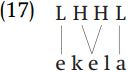
This would not be distinct from the simple tone melody LHL: (17) says that the vowel e should be produced at high pitch at the beginning and at the end, with no other pitches being produced. The Twin Sister Convention was proposed as a constraint on the theory, so that such a phonetically indistinguishable representation is formally disallowed.

Another illustration of the autosegmental treatment of tone preservation comes from Mongo. When vowels are brought together, either directly in the underlying representation or as the result of deleting certain consonants, the vowel sequence is reduced to a single vowel which preserves all of the component tones of the two vowels. This can result not just in the simple contours R and F, but also in the complex three-tone contours fall–rise (FR) and rise–fall (RF).
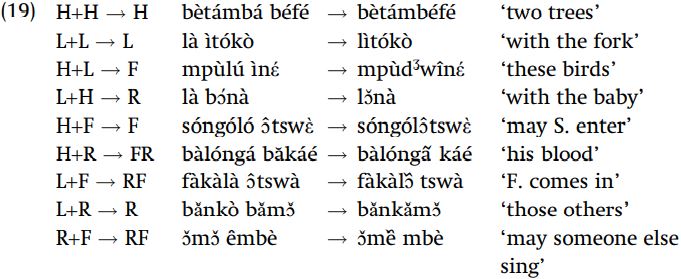
The derivation of the last example illustrates how the autosegmental theory explains the pattern elegantly. In this case, the first vowel deletes, causing its two tones to become floating. Those tones are associated with the following vowel by the Well-formedness Conditions. This results in two adjacent H tones on one vowel, which by the Twin Sister Convention reduce to one H, giving the phonetic output.
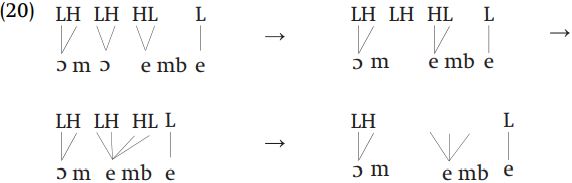
The fact that the theory effortlessly handles three-tone contours, when the linear theory struggled to handle even two-tone contours, is clear evidence that autosegmental theory is the better theory.
الاكثر قراءة في Phonology
اخر الاخبار
اخبار العتبة العباسية المقدسة
الآخبار الصحية

قسم الشؤون الفكرية يصدر كتاباً يوثق تاريخ السدانة في العتبة العباسية المقدسة
"المهمة".. إصدار قصصي يوثّق القصص الفائزة في مسابقة فتوى الدفاع المقدسة للقصة القصيرة
(نوافذ).. إصدار أدبي يوثق القصص الفائزة في مسابقة الإمام العسكري (عليه السلام)


