The problem of contours
One possibility is that contour tones are simply H (high) or L (low) tones with a positive specification for a feature “contour.” We could take the pitch at the beginning of a vowel as representing the “basic” tone value, and if the pitch changes from that point (either up or down), then the vowel is [+contour]. This gives us the following representations of H, L, R (rising), and F (falling) tones.

Such a theory is ultimately insufficient since it ignores tone levels (Mid, Superlow, Superhigh), but we can pursue this theory to see what progress can be made. Perhaps if this theory works, it can be modified to account for other tone levels.
An essential test of a theory of features is how it accounts for phonological processes. This theory of tone makes predictions: it predicts that R and F will be a natural class because they are [+contour], and it predicts that L and R are a natural class because they are [–H]. As it happens, some relevant typological work had been done on natural tone rules, most notably Hyman and Schuh 1974. Such research has shown that the following are fairly common tonal processes.

The problem is that the “[contour]” theory does not provide any natural way to express all of these processes. The last two processes can be formulated:

However, the first two processes cannot be formalized, since {L,F} or {H,R} are not a definable class using this theory. L tone is, ex hypothesii, [-H] whereas F is [+H], so the class of progressive tone assimilations, one of the most common tone rules, is unformalizable.
This theory also predicts the following rules, which are simply the rules in (3) with the conditioning environment on the left rather than the right:

Unlike the common rules in (2), such rules are totally nonexistent in the languages of the world. The “[contour]” theory thus makes a bad prediction, that certain processes should exist when they do not, and in addition the theory provides no way to express certain very natural processes, in particular processes where the conditioning environment is on the left. Finally, even for the two processes which the theory can formalize in (3), there is an unexplained element of arbitrariness – why should an H tone become a falling tone before [–H]? Those processes are formally just as simple to express as the rules in (5), and should therefore be found as commonly as the former set of rules, but in fact this latter set of rules is completely unattested.

It is obvious that this theory of tone is wrong, but what is the alternative? There was a long-standing intuition that contour tones were in some sense composite tones, so that R is simply a combination of an L followed by an H, and F is a combination of an H followed by an L; falling and rising pitch is simply the continuous transition between the higher and lower pitch levels that H and L define. An example of the kind of phonological patterns which were responsible for this intuition is the pattern of tone changes that result from merging vowels between words in Yekhee, illustrated below.
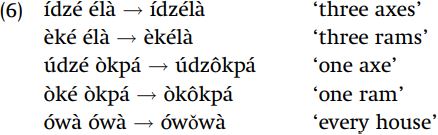
The combination of H+L results in a falling tone, and L+H results in a rising tone. How can the intuition that fall is H+L and rise is L+H be expressed in the theory?
There is little problem in doing this for contour tones on long vowels, since long vowels can be represented as a sequence of identical vowels, so treating a long rising tone as being a sequence of tones is easy.
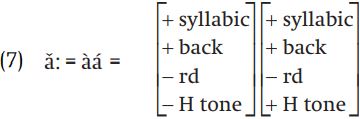
The problem is short contour tones. A single vowel cannot be both [–H tone] and [+H tone], and feature values cannot be ordered within a segment, but that is what is needed to represent short rising and falling tones.








