Abstract reanalysis in Matuumbi NC sequences
Other evidence for abstract phonology comes from a historical reanalysis of postnasal consonants in the Bantu language Matuumbi. Nouns in Bantu are composed of a prefix plus stem, and the prefix changes between singular and plural. For example, proto-Bantu mu-ntu ‘person’ contains the class 1 prefix mu- marking certain singular nouns, and the plural ba-ntu ‘people’ contains the class 2 prefix ba-. Different nouns take different noun-class prefixes (following the tradition of historical linguistics, reconstructed forms are marked with an asterisk).
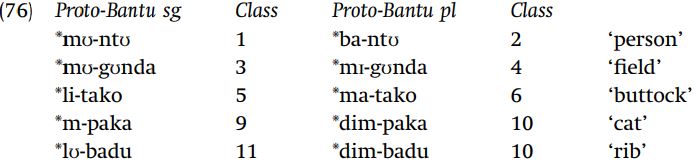
A postnasal voicing rule was added in the proto-Rufiji-Ruvuma subgroup of Bantu (a subgroup which includes Matuumbi), so that original *mpaka ‘cat’ came to be pronounced mbaka in this subgroup.
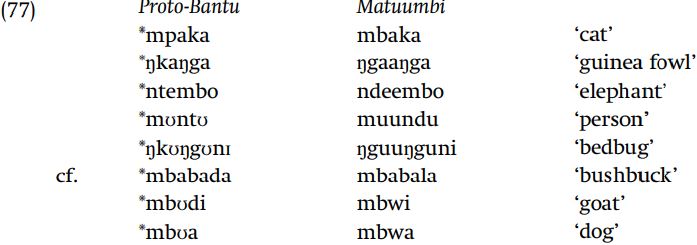
Another inconsequential change is that the class 10 prefix, originally *din-, lost di, so the class 10 prefix became completely homophonous with the class 9 prefix.
In the Nkongo dialect of Matuumbi, there was a change in the morphological system so that nouns which were originally assigned to classes 9–10 now form their plurals in class 6, with the prefix ma-. Earlier *ŋaambo ‘snake ~ snakes’ now has the forms ŋáambo ‘snake’ / ma-ŋáambo ‘snakes.’
Given surface [mbwa] ‘dog’ (proto-Bantu *m-bʊa) originally in classes 9– 10, the concrete analysis is that the underlying form in proto-Rufiji is /m-bwa/. It was always pronounced as [mbwa], since the root was always preceded by a nasal prefix. The absence of alternations in the phonetic realization of the initial consonant would give reason to think that phonetic [b] derives from underlying /b/. By the same reasoning, we predict that earlier mpaka ‘cat’ is reanalyzed as /b/, once the word came to be pronounced as mbaka in all contexts: compare Yiddish gelt.
The restructuring of the morphological system of Nkongo Matuumbi where the original class pairing 9–10 is reanalyzed as 9–6 allows us to test this prediction, since nouns with their singulars in class 9 no longer have a nasal final prefix in all forms; the plural has the prefix ma-. As the following data show, the concrete approach is wrong.
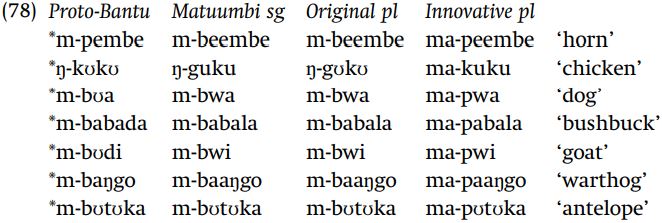
While the distinction /mp/ ~ /mb/ was neutralized, it was neutralized in favor of a phonetically more abstract consonant /p/ rather than the concrete consonant /b/.
This reanalysis did not affect all nouns which had a singular or plural in classes 9–10; it affected only nouns which originally had both their singulars and plurals in this class, i.e. only those nouns lacking alternation. Nouns with a singular in class 11 and a plural in class 10 preserve the original voicing of the consonant.
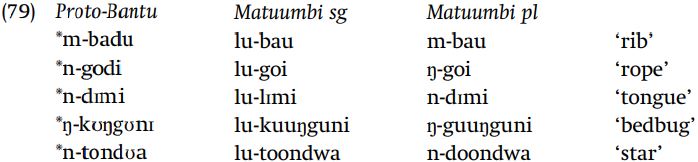
A word such as ‘rib’ always had a morphological variant which transparently revealed the underlying consonant, so the contrast between /n-toondwa/ ! [ndoondwa] and /n-goi/ ! [ŋgoi] was made obvious by the singulars [lu-toondwa] and [lu-goi].
While it is totally expected that there should be a neutralization of *mp and *mb in words like mbaka, mbwa – there would have been no evidence to support a distinction between surface [mb] deriving from /mb/ versus [mb] deriving from /mp/ – surprisingly from the viewpoint of concrete phonology, the direction of neutralization where [mb] is reanalyzed as /mp/ is unexpected. One explanation for this surprising reanalysis regards the question of markedness of different consonants. Given a choice between underlying /m + b/ and /m + p/, where either choice would independently result in [mb], one can make a phonetically conservative choice and assume /m + b/, or make a choice which selects a less marked consonant, i.e. /m + p/. In this case, it is evident that the less marked choice is selected where the choice of consonants is empirically arbitrary.
Such examples illustrating phonetically concrete versus abstract reanalyses motivated by considerations such as markedness are not well enough studied that we can explain why language change works one way in some cases, and another way in other cases. In the case of Yiddish avek from historically prior aveg, there would be no advantage at all in assuming underlying /aveg/, from the perspective of markedness or phonetic conservatism.








