Voicing and epenthesis
Lithuanian. Another example which illustrates how an earlier rule can change a form in such a way that a later rule can no longer apply is found in Lithuanian. There is a process of voicing assimilation in Lithuanian whereby obstruents agree in voicing with an immediately following obstruent. This rule applies in the following examples to the verbal prefixes /at/ and /ap/.
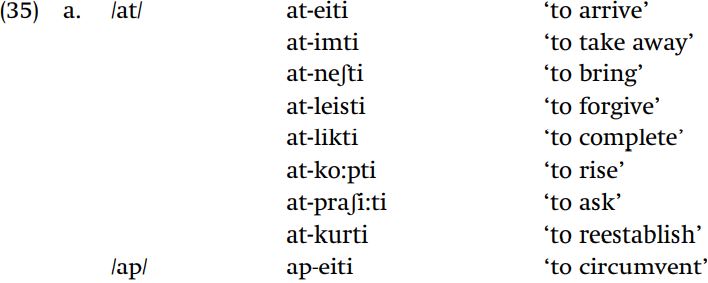
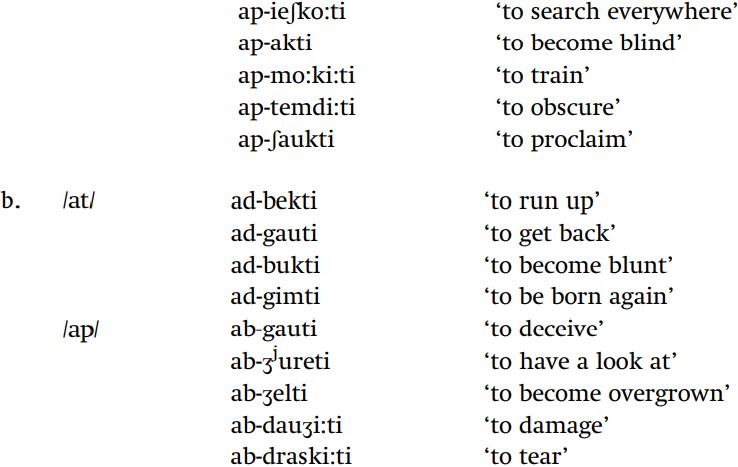
We would assume that the underlying forms of the prefixes are /at/ and /ap/, and that there is a rule which voices obstruents before voiced obstruents.

The alternative hypothesis would be that the prefixes are underlyingly /ad/ and /ab/. However, there is no natural context for describing the process of devoicing. Although devoicing of voiced obstruents before voiceless obstruents is quite natural, assuming that the prefixes have underlying voiced obstruents would also require the consonant to be devoiced before vowels and sonorant consonants, in order to account for the supposed derivations /ad-eiti/ ! [ateiti], /ab-eiti/ ! [apeiti], /ad-neʃti/ ! [atneʃti], and /ab-mo:ki:ti/ ! [apmo:ki:ti]. But there is clearly no rule prohibiting voiced obstruents before vowels and sonorants in this language (in fact, no language has ever been attested with a rule of consonant devoicing where the conditioning environment is a following vowel). On the basis of this reasoning, we conclude that the prefixes have underlying voiceless consonants.
When the initial consonant of the root is an alveolar stop, the vowel [i] appears after the prefix /at/, and similarly when the initial consonant is a bilabial stop, [i] is inserted after the consonant of /ap/.
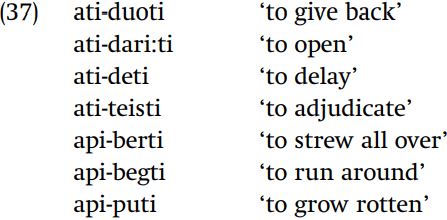
Given just the voicing assimilation rule, you would expect forms such as *[adduoti], *[abberti] by analogy to [adbekti] and [abdauʒi:ti]. Lithuanian does not allow sequences of identical consonants, so to prevent such a result, an epenthetic vowel is inserted between homorganic obstruent stops (ones having the same values for the place of articulation features).
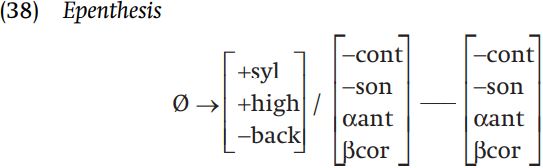
The ordering of these rules is important: epenthesis (38) must apply before voicing assimilation, since otherwise the prefix consonant would assimilate the voicing of the root-initial consonant and would then be separated from that consonant by the epenthetic vowel. The result of applying the voicing assimilation rule first would be to create [adduoti], [abberti], and then this would undergo vowel epenthesis to give incorrect *[adiduoti], *[abiberti]. If, on the other hand, epenthesis is the first rule applied, then underlying /at-duoti/ becomes [atiduoti] and /ap-berti/ becomes [apiberti]. Epenthesis eliminates the underlying cluster of obstruents, preventing the voicing rule from applying.
Armenian. Interestingly, a similar pair of rules exists in the New Julfa (Iran) dialect of Armenian, but they apply in the opposite order. If rules apply in a particular order, you would expect to find languages with essentially the same rules A and B where A precedes B in one language and B precedes A in another: this is what we find in comparing Armenian and Lithuanian.
The first-singular future prefix is underlyingly k-, as shown in (39a), where the prefix is added to a vowel-initial stem. That /k/ assimilates voicing and aspiration from an obstruent which immediately follows it underlyingly (but not across a vowel). In addition, initial consonant clusters are broken up by an epenthetic schwa. As the data in (39b) show, the prefix consonant first assimilates to the initial consonant of the root, and then is separated from that consonant by schwa.
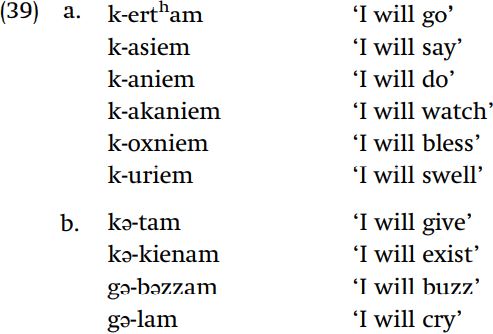
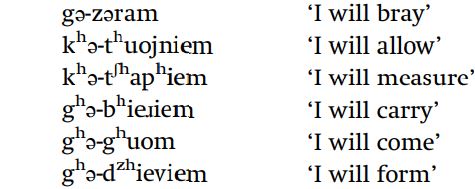
The difference between this dialect of Armenian and Lithuanian is that vowel epenthesis applies before consonant assimilation in Lithuanian but after that rule in Armenian, so that in Armenian both epenthesis and assimilation can apply to a given word, whereas in Lithuanian applying epenthesis to a word means that assimilation can no longer apply.








