

Grammar


Tenses


Present

Present Simple

Present Continuous

Present Perfect

Present Perfect Continuous


Past

Past Simple

Past Continuous

Past Perfect

Past Perfect Continuous


Future

Future Simple

Future Continuous

Future Perfect

Future Perfect Continuous


Parts Of Speech


Nouns

Countable and uncountable nouns

Verbal nouns

Singular and Plural nouns

Proper nouns

Nouns gender

Nouns definition

Concrete nouns

Abstract nouns

Common nouns

Collective nouns

Definition Of Nouns

Animate and Inanimate nouns

Nouns


Verbs

Stative and dynamic verbs

Finite and nonfinite verbs

To be verbs

Transitive and intransitive verbs

Auxiliary verbs

Modal verbs

Regular and irregular verbs

Action verbs

Verbs


Adverbs

Relative adverbs

Interrogative adverbs

Adverbs of time

Adverbs of place

Adverbs of reason

Adverbs of quantity

Adverbs of manner

Adverbs of frequency

Adverbs of affirmation

Adverbs


Adjectives

Quantitative adjective

Proper adjective

Possessive adjective

Numeral adjective

Interrogative adjective

Distributive adjective

Descriptive adjective

Demonstrative adjective


Pronouns

Subject pronoun

Relative pronoun

Reflexive pronoun

Reciprocal pronoun

Possessive pronoun

Personal pronoun

Interrogative pronoun

Indefinite pronoun

Emphatic pronoun

Distributive pronoun

Demonstrative pronoun

Pronouns


Pre Position


Preposition by function

Time preposition

Reason preposition

Possession preposition

Place preposition

Phrases preposition

Origin preposition

Measure preposition

Direction preposition

Contrast preposition

Agent preposition


Preposition by construction

Simple preposition

Phrase preposition

Double preposition

Compound preposition

prepositions


Conjunctions

Subordinating conjunction

Correlative conjunction

Coordinating conjunction

Conjunctive adverbs

conjunctions


Interjections

Express calling interjection

Phrases

Sentences


Grammar Rules

Passive and Active

Preference

Requests and offers

wishes

Be used to

Some and any

Could have done

Describing people

Giving advices

Possession

Comparative and superlative

Giving Reason

Making Suggestions

Apologizing

Forming questions

Since and for

Directions

Obligation

Adverbials

invitation

Articles

Imaginary condition

Zero conditional

First conditional

Second conditional

Third conditional

Reported speech

Demonstratives

Determiners


Linguistics

Phonetics

Phonology

Linguistics fields

Syntax

Morphology

Semantics

pragmatics

History

Writing

Grammar

Phonetics and Phonology

Semiotics


Reading Comprehension

Elementary

Intermediate

Advanced


Teaching Methods

Teaching Strategies

Assessment
Lamba: harmony and palatalization
المؤلف:
David Odden
المصدر:
Introducing Phonology
الجزء والصفحة:
128-5
29-3-2022
2533
Lamba: harmony and palatalization
The following data illustrate the interaction between a rule of vowel harmony and a palatalization rule in the language Lamba (Zambia):

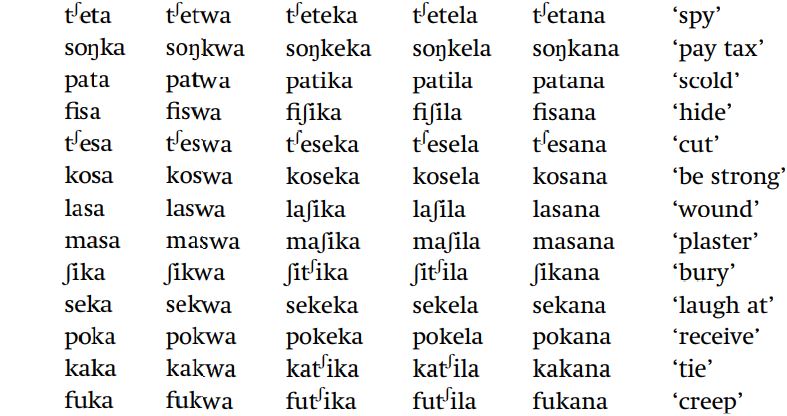
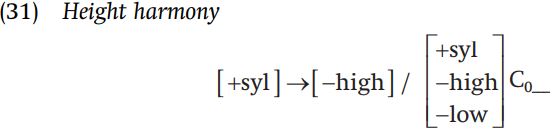
In order to see what these data show, we must first understand the morphological structure of these words, a step which leads us to realize that the pronunciation of certain morphemes changes, depending on their phonetic context. Verbs in Lamba are composed of a root of the form CV(C)C, an optional derivational affix marking passive, neuter, applied or reciprocal, and a word-final suffix -a which marks the form as being a verb. The underlying forms of the passive and reciprocal suffixes are clearly -w- and -an-, since they exhibit no phonetic variations. The neuter and applied suffixes appear phonetically as -ik- and -ek-, -il- and -el-. The choice of vowel in the suffix is determined by the vowel which precedes the suffix: if the verb root contains the vowel i, u, or a the suffix has the vowel i, and if the root contains the vowel e or o the suffix has the vowel e. The group of vowels i, u, a is not a natural phonetic class, so it is implausible that the suffixes are underlyingly -el- and -ek- with -il- and -ik- being derived by a rule. The class of vowels e, o is the phonetic class of mid vowels; it is thus evident that this language has a vowel harmony rule which assimilates underlying high vowels (in the suffixes /il/ and /ik/) to mid vowels when they are preceded by mid vowels.
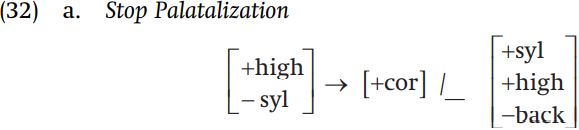
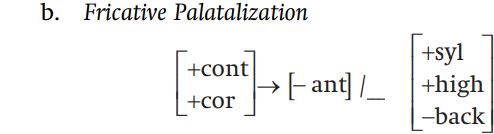
There is an alternation in the realization of certain root-final consonants. As shown in examples such as kaka ~ kat ʃ ika and lasa ~ laʃika, the velar consonants and the alveolar continuant s become alveopalatals when they are followed by the vowel i, by processes of palatalization. It is difficult to express a change of /k/ and /s/ to alveopalatal by one rule without including /t/ – which does not change, see [patika] – so two separate rules are needed.
The interaction between these processes is seen in words which could in principle undergo both of these processes: roots with the vowel e or o, and the final consonant k or s. The example sekeka ‘laugh at’ from /sek-ik-a/ shows how these processes interact. Suppose, first, that palatalization were to apply before vowel harmony. Since the underlying representation has the sequence /ki/ which is required by palatalization, that rule would apply. Subsequently, vowel harmony would assimilate /i/ to [e] after /e/, giving the wrong surface result. This is illustrated below in a derivation which spells out the results of applying first palatalization, then height harmony.

Thus, applying the rules in this order gives the wrong results: this order cannot be correct.
On the other hand, if we apply the processes in the other order, with height harmony applying before palatalization, then the correct form is generated.

الاكثر قراءة في Phonology
اخر الاخبار
اخبار العتبة العباسية المقدسة
الآخبار الصحية

قسم الشؤون الفكرية يصدر كتاباً يوثق تاريخ السدانة في العتبة العباسية المقدسة
"المهمة".. إصدار قصصي يوثّق القصص الفائزة في مسابقة فتوى الدفاع المقدسة للقصة القصيرة
(نوافذ).. إصدار أدبي يوثق القصص الفائزة في مسابقة الإمام العسكري (عليه السلام)


