Rule formulation and features
The most important function of features is to form the basis for writing rules, which is crucial in understanding what defines a possible phonological rule. A typical rule of vowel nasalization, which nasalizes all vowels before a nasal, can be formulated very simply if stated in features:

Such a rule is common in the languages of the world. Very uncommon, if it exists at all, is one nasalizing only the lax vowel [ɪ], and only before [m]. Formulated with features, that rule looks as follows:
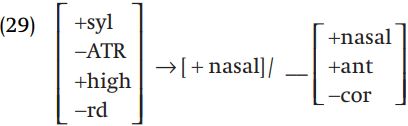
This rule requires significantly more features than (28), since [ɪ], which undergoes the rule, must be distinguished in features from other high vowels, such as [i] or [ʊ], which (in this hypothetical case) do not undergo the rule, and [m], which triggers the rule, must be distinguished from [n] or [ŋ], which do not.
Simplicity in rule writing. This relation between generality and simplicity on the one hand, and desirability or commonness on the other, has played a very important role in phonology: all things being equal, simpler rules are preferred, both for the intrinsic elegance of simple rules and because they correlate with more general classes of segments. Maximum generality is an essential desideratum of science.
The idea that rules are stated in terms of the simplest, most general classes of phonetically defined segments has an implication for rule formulation. Suppose we encounter a rule where high vowels (but not mid and low vowels) nasalize before nasal stops (n, m, ŋ), thus in ! ĩn, uŋ ! ũŋ, and so on. We would formulate such a rule as follows:

However, we could equally well formalize the rule as:
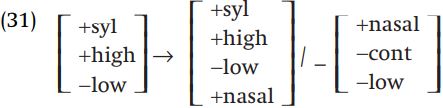
We could freely add [-low] to the specification of the input segment (since no vowel can be [+high, +low] , thus high vowels automatically would pass that condition), and since the same class of vowels is referenced, inclusion of [-low] is empirically harmless. Saying that the vowel becomes [+syl, +high, -low] is harmless, since the vowel that undergoes the change already has these specifications. At the same time, the additional features in (31) are useless complications, so on the theoretical grounds of simplicity, we formalize the rule as (30). In writing phonological rules, we specify only features which are mandatory. A formulation like would mention fewer features, but it would be wrong given the facts which the rule is supposed to account for, since the rule should state that only high vowels nasalize, but this rule nasalizes all vowels.

Likewise, we could complicate the rule by adding the retriction that only non-nasal vowels are subject to (30): in (30), we allow the rule to vacuously apply to high vowels that are already nasal. There is (and could be) no direct evidence which tells us whether /ĩn/ undergoes (30) and surfaces as [ĩn], or /ĩn/ is immune to (30) and surfaces as [ĩn]; and there is no conceptual advantage to complicating the rule to prevent it from applying in a context where we do not have definitive proof that the rule applies. The standard approach to rule formalization is, therefore, to write the rule in the simplest possible way, consistent with the facts.
Formalizability. The claim that rules are stated in terms of phonetically defined classes is essentially an axiom of phonological theory. What are the consequences of such a restriction? Suppose you encounter a language with a phonological rule of the type {p, r} ! {i, b}/ _ {o, n}. Since the segments being changed (p and r) or conditioning the change (o and n) cannot be defined in terms of any combination of features, nor can the changes be expressed via any features, the foundation of phonological theory would be seriously disrupted. Such a rule would refute a fundamental claim of the theory that processes must be describable in terms of these (or similar) features. This is what it means to say that the theory makes a prediction: if that prediction is wrong, the theory itself is wrong.
Much more remains to be said about the notion of “possible rule” in phonology; nevertheless, we can see that distinctive feature theory plays a vital role in delimiting possible rules, especially in terms of characterizing the classes of segments that can function together for a rule. We now turn to a discussion of rule formalism, in the light of distinctive feature theory.








