The concerns of phonology
As a step towards understanding what phonology is, and especially how it differs from phonetics, we will consider some specific aspects of sound structure that would be part of a phonological analysis. The point which is most important to appreciate at this moment is that the “sounds” which phonology is concerned with are symbolic sounds – they are cognitive abstractions, which represent but are not the same as physical sounds.
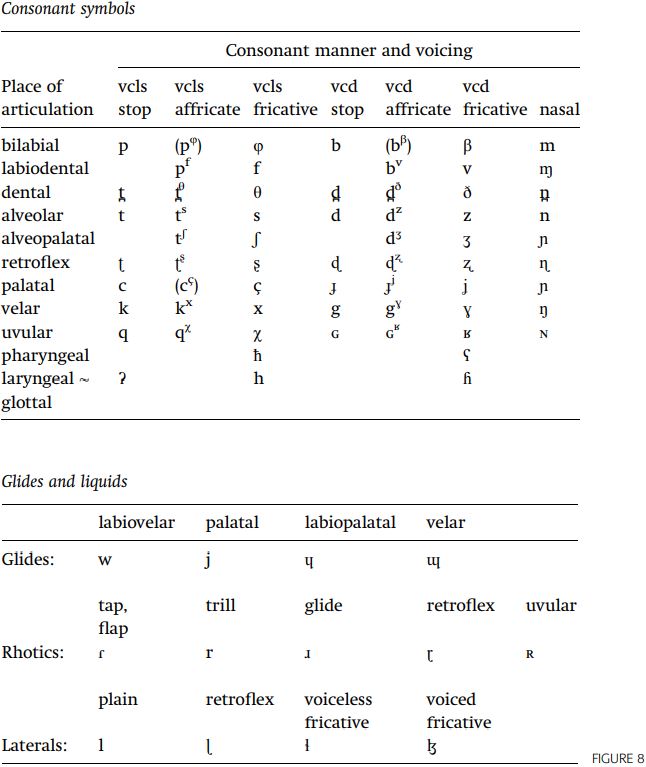
The sounds of a language. One aspect of phonology investigates what the “sounds” of a language are. We would want to take note in a description of the phonology of English that we lack the vowel [ø] that exists in German in words like schön ‘beautiful,’ a vowel which is also found in French (spelled eu, as in jeune ‘young’), or Norwegian (øl ‘beer’). Similarly, the consonant [θ] exists in English (spelled th in thing, path), as well as Icelandic, Modern Greek, and North Saami), but not in German or French, and not in Latin American Spanish (but it does occur in Continental Spanish in words such as cerveza ‘beer’).
Sounds in languages are not just isolated atoms; they are part of a system. The systems of stops in Hindi and English are given in (1).
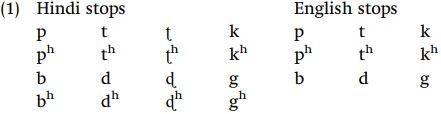
The stop systems of these languages differ in three ways. English does not have a series of voiced aspirated stops like Hindi [bh dh ɖh gh ], nor does it have a series of retroflex stops [ʈ ʈh ɖ ɖh ]. Furthermore, the phonological status of the aspirated sounds [ph t h kh ] is different in the languages, as discussed in chapter 2, in that they are basic lexical facts of words in Hindi, but are the result of applying a rule in English.
Rules for combining sounds. Another aspect of language sound which a phonological analysis takes account of is that in any language, certain combinations of sounds are allowed, but other combinations are systematically impossible. The fact that English has the words [bɹɪk] brick, [bɹejk] break, [bɹɪdʒ ] bridge, [bɹɛd] bread is a clear indication that there is no restriction against having words that begin with the consonant sequence br; besides these words, one can think of many more words beginning with br such as bribe, brow and so on. Similarly, there are many words which begin with bl, such as [bluw] blue, [bleʔn̩ t] blatant, [blæst] blast, [blɛnd] blend, [blɪŋk] blink, showing that there is no rule against words beginning with bl. It is also a fact that there is no word *[blɪk]1 in English, even though the similar words blink, brick do exist. The question is, why is there no word *blick in English? The best explanation for the nonexistence of this word is simply that it is an accidental gap – not every logically possible combination of sounds which follows the rules of English phonology is found as an actual word of the language.
Native speakers of English have the intuition that while blick is not a word of English, it is a theoretically possible word of English, and such a word might easily enter the language, for example via the introduction of a new brand of detergent. Sixty years ago the English language did not have any word pronounced [bɪk], but based on the existence of words like big and pick, that word would certainly have been included in the set of nonexistent but theoretically allowed words of English. Contemporary English, of course, actually does have that word – spelled Bic – which is the brand name of a ballpoint pen.
While the nonexistence of blick in English is accidental, the exclusion from English of many other imaginable but nonexistent words is based on a principled restriction of the language. While there are words that begin with sn like snake, snip, and snort, there are no words beginning with bn, and thus *bnick, *bnark, *bniddle are not words of English. There simply are no words in English which begin with bn. Moreover, native speakers of English have a clear intuition that hypothetical *bnick, *bnark, *bniddle could not be words of English. Similarly, there are no words in English which are pronounced with pn at the beginning, a fact which is not only demonstrated by the systematic lack of words such as *pnark, *pnig, *pnilge, but also by the fact that the word spelled pneumonia which derives from Ancient Greek (a language which does allow such consonant combinations) is pronounced [nʌ̍monjə] without p. A description of the phonology of English would provide a basis for characterizing such restrictions on sequences of sounds.
Variations in pronunciation. In addition to providing an account of possible versus impossible words in a language, a phonological analysis will explain other general patterns in the pronunciation of words. For example, there is a very general rule of English phonology which dictates that the plural suffix on nouns will be pronounced as [ɨz], represented in spelling as es, when the preceding consonant is one of a certain set of consonants including [ʃ] (spelled sh) as in bushes, [tʃ ] (spelled as ch) as in churches, and [dʒ ] (spelled j, ge, dge) as in cages, bridges. This pattern of pronunciation is not limited to the plural, so despite the difference in spelling, the possessive suffix s 2 is also subject to the same rules of pronunciation: thus, plural bushes is pronounced the same as the possessive bush’s, and plural churches is pronounced the same as possessive church’s.
This is the sense in which phonology is about the sounds of language. From the phonological perspective, a “sound” is a specific unit which combines with other such specific units, and which represents physical sounds. What phonology is concerned with is how sounds behave in a grammar.








