Vowel features and allophonic rules
Once phonemic contrasts have been established for the accent in question, and the appropriate representation for each phoneme has been selected, the realizations of those phonemes must be determined and rules written to describe allophonic variation. Again, features and rule notation can be used to formalize these statements. We saw that vowels are [+syllabic, –consonantal, +sonorant, +voice, –nasal]. To distinguish English vowels appropriately, we also require the features [±high], [±mid] for the dimension of tongue height; [±front], [±back] for place of articulation; and [±round]. These give the illustrative matrix in (5).
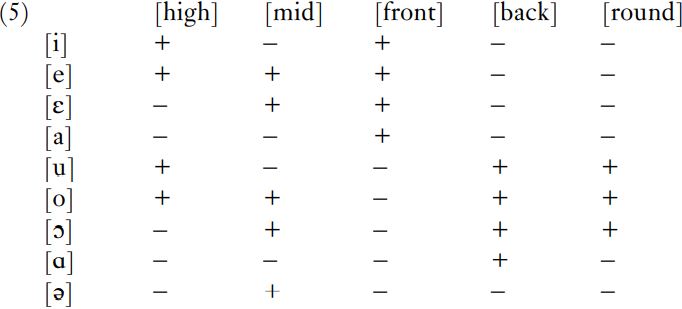
These features can distinguish four contrastive degrees of vowel height, and three degrees of frontness, which allows all varieties of English to be described. However, /i:/ and /I/, and /u:/ and /υ/, will be identical in this matrix. In SSBE and GA, the former in each pair is typically long, and the latter short; and long vowels are also articulated more extremely, or more peripherally than corresponding short ones: the long high front vowel is higher and fronter than the short high front vowel, while the long high back vowel is higher and backer than its short counterpart. The question is whether we regard this as primarily a quality or a quantity difference. If we take quality as primary, we can regard /i/, /u/, /ɑ/, /ɔ/ as [+tense], or more peripheral, and simply write a redundancy rule to say that all tense vowels are phonetically long. On the other hand, we could do the opposite, and take length as the important factor, so these vowels are long /i:/, /u:/, /ɑ:/ and /ɔ:/, and redundantly also more peripheral.
For most accents of English, we could choose either solution, although most phonologists would select either length or tenseness as relevant at the phoneme level, with the other simply following automatically, to minimize redundancy in the system. However, in SSE and Scots dialects, it matters which we choose. This is because vowels in Scottish accents (and some related Northern Irish accents) are unique among varieties of English in one respect: we can predict where vowels are phonetically long, and where they are phonetically short. Vowels become long before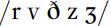 and at the end of a word, but they are short everywhere else, as shown in (6).
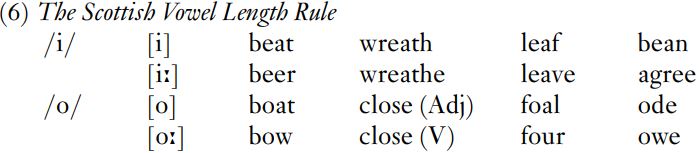
/I/, /ε/ and /A/, which are short and lax in other accents, do not lengthen in any circumstances. In SSE and Scots, then, we can define the two classes of phonemic vowels as lax (the three which never lengthen) and tense (the others, which are sometimes long and sometimes short, in predictably different environments). It is possible to predict length from [±tense], but not the other way around. The allophonic rule involved will then state that tense vowels lengthen before /r/, before a voiced fricative, or before a word boundary (that is, in word-final position), to account for the data in (6).
Other allophonic rules are more general. For instance, in all varieties of English, vowels become nasalized immediately before nasal consonants; the velum lowers in anticipation of the forthcoming nasal, and allows air to flow through the nasal as well as the oral cavity during the production of the vowel. If you produce cat and can, then regardless of whether your vowel is front or back, there will be a slight difference in quality due to nasalization in the second case; you may hear this as a slight lowering of the pitch. This rule is shown in (7); note that the symbol V here means ‘any vowel’.

Just as for consonants, then, some allophonic rules specifying the realizations of vowel phonemes are found very generally in English (and may in fact, as in the case of the nasalization process in (7), reflect universal phonetic tendencies); others, like the Scottish Vowel Length Rule, are peculiar to certain accents.








