The English Perfect
Another syntactic construction central to the tense–aspect system of English is the Perfect, exemplified in (17).

Analysts have found it difficult to classify the Perfect as an aspect or a tense. It has two constituents, has or have and a past participle, here blocked. (The label ‘participle’ is not helpful; it derives from the Latin words meaning ‘take part’ or ‘participate’ and is supposed to reflect the fact that in, for example, the Perfect construction, words such as blocked participate in two word classes. Blocked is related to the verb block but is itself a sort of adjective – compare The blocked track.) The participle indicates an action that is completed, and this is why the Perfect looks like an aspect; but has signals present time, and this makes the Perfect look like a tense. On the assumption that some constructions may simply be indeterminate, we make no attempt here to solve the problem.
The Perfect has been defined as focusing upon the presently accessible consequences of a past event, rather than upon the past event per se; this is summed up in the traditional formula that the Perfect has current relevance. The Perfect in standard written English has four major uses, exemplified in (18).

Examples (18a–d) go from the most accessible to the least accessible consequences. The speaker who utters (18a) has the finished thesis to show (on disk or in paper form). If (18b) is uttered, the listeners know that the Minister is there with them. The speaker who utters (18c) is saying ‘I started work six hours ago and as you can see I am still here, mission unaccomplished’. The consequences of these three examples are visible, as are the consequences of (17), another resultative.
The consequences of (18d) are not so obvious. The question is about a possible visit at an unspecified time in the past, hence the term ‘indefinite anterior’. The answer, Yes, I have been there, does not specify a time but merely contains an assertion that a visit to Doubtful Sound took place. The consequences might be that the speaker can provide information about how to get to Doubtful Sound, or has happy memories of the landscape and sea, or still has lumps from the bites of the amazingly vicious sandflies.
The English Perfect has been the subject of much debate and analysis, and we can do no more than indicate the main points. We close this section with comments on three aspects of the English Perfect that are in need of investigation. Insufficient attention has been given to the role of just, in (18b), and of ever, in (18d), as demarcating the hot-news Perfect and the experiential Perfect from the other interpretations. Should (18b) and (18d) be treated as separate constructions, not just separate interpretations?
In written English the Perfect excludes definite time adverbs – *The snow has blocked the track last Monday evening. This appears to be because the Perfect focuses on the current, accessible consequences of an action, and speakers using the Perfect are not concerned with the action and time of action in the past. In spoken English, particularly spontaneous spoken English, this exclusion of definite past-time adverbs is beginning to break down.
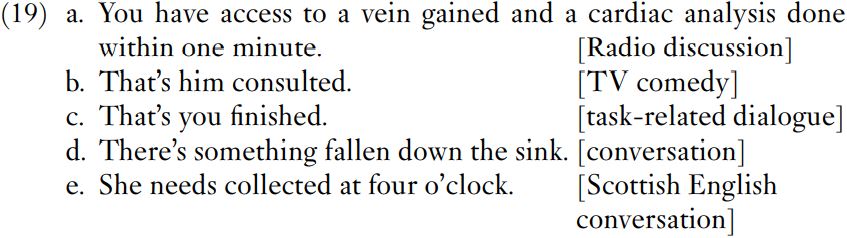
Finally, we should note that past participles were originally resultative, that is, they expressed the result of a completed action. The participles survive in a number of resultative constructions, not just in the resultative Perfect. Examples are given in (19). They are all examples taken from spontaneous speech.