Roles, grammar and meaning
Why discuss roles? The first part of the reply is that concepts such as Agent, Patient, Instrument and so on are regularly used in accounts of the active and passive constructions, of prepositions in English and of prepositions and case suffixes in other languages, and with respect to various syntactic structures. It is essential to understand the difficulties in defining roles and to be aware of what counts as good practice in this area of grammar. The second part of the reply is that the concept of roles has never failed to elicit an immediate interested response from students. To use a colloquial phrase, it rings a bell and deserves to be explored. The third part of the reply is that roles are used in descriptions of many languages other than English.
We saw on clauses that clauses denote situations. Situations are analyzed as consisting of a state or event in which certain types of participants take part. There are central participants, such as Agent and Patient, and peripheral participants (which some analysts call ‘circumstances’) such as Place and Time. The distinction between the central participants and the peripheral circumstances largely corresponds to the distinction between the core of a clause and the periphery of a clause. We mentioned a further distinction between the nucleus and core of a clause, the nucleus being a verb or BE plus an adjective, say. The nucleus corresponds to the state or event at the center of any situation.
Let us look briefly at some examples illustrating how we can put roles to work. They can be used in the analysis of constructions that have the same syntactic structure but different sets of roles. Consider (1) and (2).
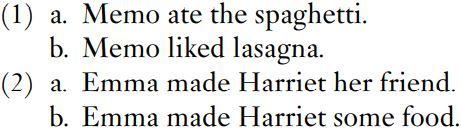
In the situation denoted by (1a), Memo is involved in an action, but not in the situation denoted by (1b); he has different roles, although in both Memo is the subject. In the situation described by (2a), Emma does something to Harriet, whereas in (2b) Emma does something for Harriet. Again, Harriet plays different roles although Harriet is the indirect object in both examples.
NPs can be conjoined, as shown in (3). Certain restrictions apply, and examples that break the restrictions sound odd, such as (3a, b).

In (3a), I refers to an Agent, but the quiche does not. In (3b), her mother refers to the recipient of the omelet, but the kitchen certainly does not refer to a recipient. Coordinated NPs must have the same role.
Roles are also relevant to the neutral order of prepositions, as in (4).
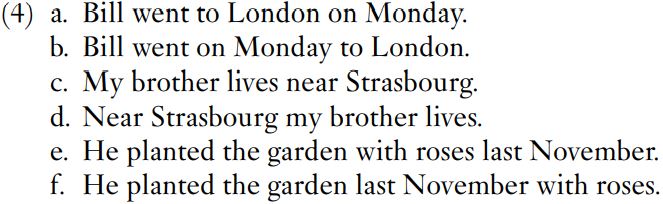
Example (4a) shows normal neutral word order – goal phrase to London followed by time phrase on Monday. The reverse order in (4b) is not neutral, and is even peculiar out of context. The key point is that, since all the phrases are prepositional phrases, there is no difference in constituent structure. What is different is the role attaching to the NP in the prepositional phrase.
Example (4c) shows the neutral order with a verb such as live – location phrase at the end of the clause. Example (4d) has the location phrase at the front of the clause, which is not neutral order and could only be used if another speaker had used the phrase near Strasbourg and the speaker of (4d) picked up the phrase and emphasized it. Examples (4e) and (4f ) are parallel to (4a) and (4b); note that last November can be moved to the front of the clause but moving with roses to the front of the clause produces a very peculiar example.








