Direct object
The concept of direct object is as widely used as that of subject and has just as long a tradition. Nonetheless, it too turns out to be elusive. As with grammatical subject, it is possible to provide criteria for direct objects in English, but the criteria do not necessarily carry over to other languages. Keeping to the [ACTIVE DECLARATIVE] construction, we can say that in sentences such as (13) the NP following the verb is the direct object.
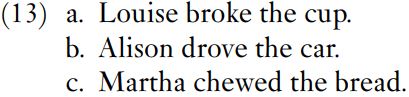
We can say that the direct object NP is never preceded by a preposition – in the sentence Martha chewed on the bread, bread is not a direct object, and the entity it denotes is not completely affected by the action of chewing. Neutral active declarative sentences typically have passive counterparts. One of the properties of the English NPs called direct objects is that they correspond to the grammatical subjects of passive sentences. This is shown in (14a–c), the passive counterparts of (13a–c).
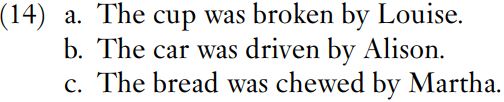
We can say that direct object NPs typically refer to Patients. Even for English alone, difficulties appear. One problem is that the criteria, even with the help of the weasel adverb typically, do not extend unequivocally to other constructions. Consider the passive sentences in (15).
 These passive sentences contain grammatical subjects (on the criteria applicable to English), but their active counterparts do not contain direct objects – compare (16).

In (16), the correspondents of the grammatical subjects in (15) are inside prepositional phrases: to a girl, over these fields. The examples show that either more than direct objects can be converted to grammatical subjects in the passive construction or we have to regard chat to and march over as single verbs that take direct objects.
Another difficulty with English is that some apparent active transitive clauses have no corresponding passive: That car weighs two tons is not matched by *Two tons are weighed by that car, Arthur measures six feet is not matched by *Six feet are measured by Arthur, Her daughters resemble Lucy is not matched by *Lucy is resembled by her daughters and The cage contained a panda cannot be converted to *A panda was contained by the cage. It has been suggested that, for example, in The cage contained a panda, the panda is not a Patient, But nobody has suggested that the panda is not a direct object.
In spite of the reservations mentioned above, in the [NEUTRAL, ACTIVE DECLARATIVE] construction of English we do have criteria for recognizing direct objects with most verbs combining with two NPs. (We exclude the copula construction, ‘copula’ including BE, GET, SEEM, BECOME and others.) Another criterion that has been proposed for direct objects in English relates to the positions occupied by particles such as back. Where a verb combines with two NPs, the particle occurs after the verb, but before or after the direct object NP, as in (17).

In clauses with three NPs, the occurrence of the particle is limited.

Example (18b) is bad, although back is in the same position as (17a), between the verb and the immediately following noun phrase. Example (18c) is not acceptable to all speakers, although back follows the NP immediately to the right of the verb. To be balanced against this criterion is the fact that her cousin in (18a) can become the grammatical subject of the corresponding passive: Her cousin was sent back the diamond necklace by Ayala. Which of the two criteria is to be given precedence: the position of back or becoming grammatical subject of the passive?
Another complication that deserves mention is that pronouns behave differently from full NPs with respect to back. Example (18c) merits no more than a question mark, but the substitution of him for her cousin yields an acceptable sentence: Ayala sent him back the diamond necklace. (Interestingly, other particles, such as away, exclude potential direct objects. They allow prepositional phrases, as in Ayala sent away the diamond necklace to her cousin; but compare *Ayala sent her cousin away the diamond necklace.)
The general picture of direct object in English is fragmented, unlike the picture of grammatical subject. The latter can be recognized for any construction, but for direct object only one construction provides solid evidence, the basic active declarative construction, both in itself and in its relationship with the passive. As for the concept of subject, one criterion can be added for some languages other than English; as shown in (12a) and (12b), direct object nouns are in the accusative case.








