Geometric Distribution
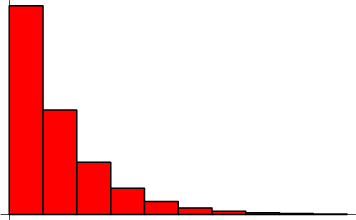
The geometric distribution is a discrete distribution for  , 1, 2, ... having probability density function
where  ,
,  , and distribution function is
The geometric distribution is the only discrete memoryless random distribution. It is a discrete analog of the exponential distribution.
Note that some authors (e.g., Beyer 1987, p. 531; Zwillinger 2003, pp. 630-631) prefer to define the distribution instead for  , 2, ..., while the form of the distribution given above is implemented in the Wolfram Language as GeometricDistribution[p].
 is normalized, since
 |
(5)
|
The raw moments are given analytically in terms of the polylogarithm function,
This gives the first few explicitly as
The central moments are given analytically in terms of the Lerch transcendent as
This gives the first few explicitly as
so the mean, variance, skewness, and kurtosis excess are given by
For the case  (corresponding to the distribution of the number of coin tosses needed to win in the Saint Petersburg paradox) the formula (23) gives
 |
(24)
|
The first few raw moments are therefore 1, 3, 13, 75, 541, .... Two times these numbers are OEIS A000629, which have exponential generating functions  and
and  . The mean, variance, skewness, and kurtosis excess of the case
  are given by
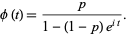
The characteristic function is given by
 |
(29)
|
The first cumulant of the geometric distribution is
 |
(30)
|
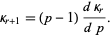
and subsequent cumulants are given by the recurrence relation
 |
(31)
|
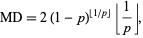
The mean deviation of the geometric distribution is
 |
(32)
|
where  is the floor function.
REFERENCES:
Beyer, W. H. CRC Standard Mathematical Tables, 28th ed. Boca Raton, FL: CRC Press, pp. 531-532, 1987.
Sloane, N. J. A. Sequence A000629 in "The On-Line Encyclopedia of Integer Sequences."
Spiegel, M. R. Theory and Problems of Probability and Statistics. New York: McGraw-Hill, p. 118, 1992.
Zwillinger, D. (Ed.). CRC Standard Mathematical Tables and Formulae, 31st ed. Boca Raton, FL: CRC Press, pp. 630-631, 2003.








