Run
A run is a sequence of more than one consecutive identical outcomes, also known as a clump.
Let  be the probability that a run of
  or more consecutive heads appears in
  independent tosses of a coin (i.e.,
  Bernoulli trials). This is equivalent to repeated picking from an urn containing two distinguishable objects with replacement after each pick. Let the probability of obtaining a head be
  . Then there is a beautiful formula for
  given in terms of the coefficients of the generating function
 |
(1)
|
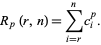
(Feller 1968, p. 300). Then
 |
(2)
|
The following table gives the triangle of numbers  for
for  , 2, ... and
  , 2, ...,
  (OEIS A050227).
| Sloane |
A000225 |
A008466 |
A050231 |
A050233 |
|
|
|
|
 |
1 |
2 |
3 |
4 |
5 |
6 |
7 |
8 |
| 1 |
1 |
0 |
0 |
0 |
0 |
0 |
0 |
0 |
| 2 |
3 |
1 |
0 |
0 |
0 |
0 |
0 |
0 |
| 3 |
7 |
3 |
1 |
0 |
0 |
0 |
0 |
0 |
| 4 |
15 |
8 |
3 |
1 |
0 |
0 |
0 |
0 |
| 5 |
31 |
19 |
8 |
3 |
1 |
0 |
0 |
0 |
| 6 |
63 |
43 |
20 |
8 |
3 |
1 |
0 |
0 |
| 7 |
127 |
94 |
47 |
20 |
8 |
3 |
1 |
0 |
| 8 |
255 |
201 |
107 |
48 |
20 |
8 |
3 |
1 |
The special case  gives the sequence
 |
(3)
|
where  is a Fibonacci number. Similarly, the probability that no
  consecutive tails will occur in
  tosses is given by
  , where
  is a Fibonacci k-step number.
Feller (1968, pp. 278-279) proved that for  ,
,
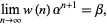 |
(4)
|
where
(OEIS A086253) is the positive root of the above polynomial and
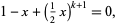
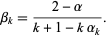
(OEIS A086254) is the positive root of the above polynomial. The corresponding constants for a run of  heads are
  , the smallest positive root of
 |
(10)
|
and
 |
(11)
|
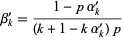
These are modified for unfair coins with  and
and  to
to  , the smallest positive root of
 |
(12)
|
and
 |
(13)
|
(Feller 1968, pp. 322-325).
Given  Bernoulli trials with a probability of success (heads)
  , the expected number of tails is
  , so the expected number of tail runs
  is
is  . Continuing,
 |
(14)
|
is the expected number of runs  . The longest expected run is therefore given by
![R=log_(1/p)[n(1-p)]](https://mathworld.wolfram.com/images/equations/Run/NumberedEquation10.gif) |
(15)
|
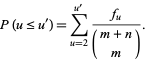
(Gordon et al. 1986, Schilling 1990). Given  0s and
  1s, the number of possible arrangements with
  runs is
![f_u=<span style=]() {2(m-1; k-1)(n-1; k-1) u=2k; (m-1; k)(n-1; k-1)+(m-1; k-1)(n-1; k) u=2k+1 " src="https://mathworld.wolfram.com/images/equations/Run/NumberedEquation11.gif" style="height:78px; width:324px" /> {2(m-1; k-1)(n-1; k-1) u=2k; (m-1; k)(n-1; k-1)+(m-1; k-1)(n-1; k) u=2k+1 " src="https://mathworld.wolfram.com/images/equations/Run/NumberedEquation11.gif" style="height:78px; width:324px" /> |
(16)
|
for  an integer, where
  is a binomial coefficient (Johnson and Kotz 1968, p. 268). Then
 |
(17)
|
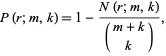
Now instead consider picking of  objects without replacement from a collection of
  containing
  indistinguishable objects of one type and
  indistinguishable objects of another. Let
  denote the number of permutations of these objects in which no
  -run occurs. For example, there are 6 permutations of two objects of type
  and two of type
  . Of these,
  ,
,  ,
,  , and
, and  contain runs of length two, so
  . In general, the probability that an
  -run does occur is given by
 |
(18)
|
where  is a binomial coefficient. Bloom (1996) gives the following recurrence sequence for
  ,
,
 |
(19)
|
where  for
for  or
or  negative and
![e(r;m,k)=<span style=]() {1 if m=0 and 0<=k<r; -1 if m=r and 0<=k<r; 0 otherwise. " src="https://mathworld.wolfram.com/images/equations/Run/NumberedEquation15.gif" style="height:62px; width:238px" /> {1 if m=0 and 0<=k<r; -1 if m=r and 0<=k<r; 0 otherwise. " src="https://mathworld.wolfram.com/images/equations/Run/NumberedEquation15.gif" style="height:62px; width:238px" /> |
(20)
|
Another recurrence which has only a fixed number of terms is given by
 |
(21)
|
where
![e_r^*(m,k)=<span style=]() {1 if (m,k)=(0,0) or (r,r); -1 if (m,k)=(0,r) or (r,0); 0 otherwise " src="https://mathworld.wolfram.com/images/equations/Run/NumberedEquation17.gif" style="height:62px; width:246px" /> {1 if (m,k)=(0,0) or (r,r); -1 if (m,k)=(0,r) or (r,0); 0 otherwise " src="https://mathworld.wolfram.com/images/equations/Run/NumberedEquation17.gif" style="height:62px; width:246px" /> |
(22)
|
(Goulden and Jackson 1983, Bloom 1996).
These formulas can be used to calculate the probability of obtaining a run of  cards of the same color in a deck of 52 cards. For
  , 2, ..., this yields the sequence 1, 247959266474051/247959266474052, ... (OEIS A086439 and A086440). Normalizing by multiplying by
  gives 495918532948104, 495918532948102, 495891608417946, 483007233529142, ... (OEIS A086438). The result
 |
(23)
|
disproves the assertion of Gardner (1982) that "there will almost always be a clump of six or seven cards of the same color" in a normal deck of cards.
Bloom (1996) gives the expected number of noncontiguous  -runs (i.e., split the sequence into maximal clumps of the same value and count the number of such clumps of length
  ) in a sequence of
  0s and
  1s as
1s as
 |
(24)
|
where  is the falling factorial. For
  ,
,  has an approximately normal distribution with mean and variance
REFERENCES:
Bloom, D. M. "Probabilities of Clumps in a Binary Sequence (and How to Evaluate Them Without Knowing a Lot)." Math. Mag. 69, 366-372, 1996.
Feller, W. An Introduction to Probability Theory and Its Application, Vol. 1, 3rd ed. New York: Wiley, 1968.
Finch, S. R. "Feller's Coin Tossing Constants." §5.11 in Mathematical Constants. Cambridge, England: Cambridge University Press, pp. 339-342, 2003.
Gardner, M. Aha! Gotcha: Paradoxes to Puzzle and Delight. New York: W. H. Freeman, p. 124, 1982.
Godbole, A. P. "On Hypergeometric and Related Distributions of Order  ." Commun. Stat.: Th. and Meth. 19, 1291-1301, 1990.
Godbole, A. P. and Papastavridis, G. (Eds.). Runs and Patterns in Probability: Selected Papers. New York: Kluwer, 1994.
Gordon, L.; Schilling, M. F.; and Waterman, M. S. "An Extreme Value Theory for Long Head Runs." Prob. Th. and Related Fields 72, 279-287, 1986.
Goulden, I. P. and Jackson, D. M. Combinatorial Enumeration. New York: Wiley, 1983.
Johnson, N. and Kotz, S. Discrete Distributions. New York: Wiley, 1968.
Mood, A. M. "The Distribution Theory of Runs." Ann. Math. Statistics 11, 367-392, 1940.
Philippou, A. N. and Makri, F. S. "Successes, Runs, and Longest Runs." Stat. Prob. Let. 4, 211-215, 1986.
Schilling, M. F. "The Longest Run of Heads." Coll. Math. J. 21, 196-207, 1990.
Schuster, E. F. In Runs and Patterns in Probability: Selected Papers (Ed. A. P. Godbole and S. Papastavridis). Boston, MA: Kluwer, pp. 91-111, 1994.
Sloane, N. J. A. Sequences A000225/M2655, A008466, A050227, A050231, A050232, A050233, A086253, A086254, A086438, A086439, and A086440 in "The On-Line Encyclopedia of Integer Sequences."








