0
EN
1
المرجع الالكتروني للمعلوماتية

تاريخ الرياضيات

الاعداد و نظريتها

تاريخ التحليل

تار يخ الجبر

الهندسة و التبلوجي

الرياضيات في الحضارات المختلفة

العربية

اليونانية

البابلية

الصينية

المايا

المصرية

الهندية

الرياضيات المتقطعة

المنطق

اسس الرياضيات

فلسفة الرياضيات

مواضيع عامة في المنطق

الجبر

الجبر الخطي

الجبر المجرد

الجبر البولياني

مواضيع عامة في الجبر

الضبابية

نظرية المجموعات

نظرية الزمر

نظرية الحلقات والحقول

نظرية الاعداد

نظرية الفئات

حساب المتجهات

المتتاليات-المتسلسلات

المصفوفات و نظريتها

المثلثات

الهندسة

الهندسة المستوية

الهندسة غير المستوية

مواضيع عامة في الهندسة

التفاضل و التكامل

المعادلات التفاضلية و التكاملية

معادلات تفاضلية

معادلات تكاملية

مواضيع عامة في المعادلات

التحليل

التحليل العددي

التحليل العقدي

التحليل الدالي

مواضيع عامة في التحليل

التحليل الحقيقي

التبلوجيا

نظرية الالعاب

الاحتمالات و الاحصاء

نظرية التحكم

بحوث العمليات

نظرية الكم

الشفرات

الرياضيات التطبيقية

نظريات ومبرهنات

علماء الرياضيات

500AD

500-1499

1000to1499

1500to1599

1600to1649

1650to1699

1700to1749

1750to1779

1780to1799

1800to1819

1820to1829

1830to1839

1840to1849

1850to1859

1860to1864

1865to1869

1870to1874

1875to1879

1880to1884

1885to1889

1890to1894

1895to1899

1900to1904

1905to1909

1910to1914

1915to1919

1920to1924

1925to1929

1930to1939

1940to the present

علماء الرياضيات

الرياضيات في العلوم الاخرى

بحوث و اطاريح جامعية

هل تعلم

طرائق التدريس

الرياضيات العامة

نظرية البيان

قم بتسجيل الدخول اولاً لكي يتسنى لك الاعجاب والتعليق.

Correlation Coefficient--Bivariate Normal Distribution

المؤلف:  Bevington, P. R.

المصدر:  Data Reduction and Error Analysis for the Physical Sciences. New York: McGraw-Hill, 1969.

الجزء والصفحة:  ...

27-3-2021

4952

+

-

20

Correlation Coefficient--Bivariate Normal Distribution

For a bivariate normal distribution, the distribution of correlation coefficients is given by

P(r) = 1/pi(N-2)(1-r^2)^((N-4)/2)(1-rho^2)^((N-1)/2)int_0^infty(dbeta)/((coshbeta-rhor)^(N-1))

(1)

= 1/pi(N-2)(1-r^2)^((N-4)/2)(1-rho^2)^((N-1)/2)sqrt(pi/2)(Gamma(N-1))/(Gamma(N-1/2))×(1-rhor)^(-(N-3/2))_2F_1(1/2,1/2,(2N-1)/2;(rhor+1)/2)

(2)

= ((N-2)Gamma(N-1)(1-rho^2)^((N-1)/2)(1-r^2)^((N-4)/2))/(sqrt(2pi)Gamma(N-1/2)(1-rhor)^(N-3/2))×[1+1/4(rhor+1)/(2N-1)+9/(16)((rhor+1)^2)/((2N-1)(2N+1))+...],

(3)

where rho is the population correlation coefficient, _2F_1(a,b;c;x) is a hypergeometric function, and Gamma(z) is the gamma function (Kenney and Keeping 1951, pp. 217-221). The moments are

<r> = rho-(rho(1-rho^2))/(2n)

(4)

var(r) = ((1-rho^2)^2)/n(1+(11rho^2)/(2n)+...)

(5)

gamma_1 = (6rho)/(sqrt(n))(1+(77rho^2-30)/(12n)+...)

(6)

gamma_2 = 6/n(12rho^2-1)+...,

(7)

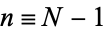
where n=N-1. If the variates are uncorrelated, then rho=0 and

_2f_1(1/2,1/2,(2n-1)/2;(rhor+1)/2) = _2F_1(1/2,1/2,(2N-1)/2;1/2)

(8)

= (Gamma(N-1/2)2^(3/2-N)sqrt(pi))/([Gamma(N/2)]^2),

(9)

so

P(r) = ((N-2)Gamma(N-1))/(sqrt(2pi)Gamma(N-1/2))(1-r^2)^((N-4)/2)(Gamma(N-1/2)2^(3/2-N)sqrt(pi))/([Gamma(N/2)]^2)

(10)

= (2^(1-N)(N-2)Gamma(N-1))/([Gamma(N/2)]^2)(1-r^2)^((N-4)/2).

(11)

But from the Legendre duplication formula,

 sqrt(pi)Gamma(N-1)=2^(N-2)Gamma(N/2)Gamma((N-1)/2),

(12)

so

P(r) = ((2^(1-N))(2^(N-2))(N-2)Gamma(N/2)Gamma((N-1)/2))/(sqrt(pi)[Gamma(N/2)]^2)(1-r^2)^((N-4)/2)

(13)

= ((N-2)Gamma((N-1)/2))/(2sqrt(pi)Gamma(N/2))(1-r^2)^((N-4)/2)

(14)

= 1/(sqrt(pi))(nu/2Gamma((nu+1)/2))/(Gamma(nu/2+1))(1-r^2)^((nu-2)/2)

(15)

= 1/(sqrt(pi))(Gamma((nu+1)/2))/(Gamma(nu/2))(1-r^2)^((nu-2)/2).

(16)

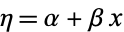
The uncorrelated case can be derived more simply by letting beta be the true slope, so that eta=alpha+betax. Then

 t=(b-beta)(s_x)/(s_y)sqrt((N-2)/(1-r^2))=((b-beta)r)/bsqrt((N-2)/(1-r^2))

(17)

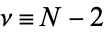
is distributed as Student's t with nu=N-2 degrees of freedom. Let the population regression coefficient rho be 0, then beta=0, so

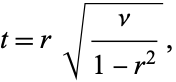
 t=rsqrt(nu/(1-r^2)),

(18)

and the distribution is

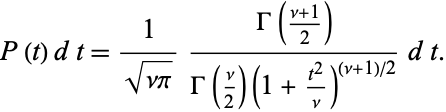
 P(t)dt=1/(sqrt(nupi))(Gamma((nu+1)/2))/(Gamma(nu/2)(1+(t^2)/nu)^((nu+1)/2))dt.

(19)

Plugging in for t and using

dt = sqrt(nu)[(sqrt(1-r^2)-r(1/2)(-2r)(1-r^2)^(-1/2))/(1-r^2)]dr

(20)

= sqrt(nu/(1-r^2))((1-r^2+r^2)/(1-r^2))dr

(21)

= sqrt(nu/((1-r)^3))dr

(22)

gives

P(t)dt = 1/(sqrt(nupi))(Gamma((nu+1)/2))/(Gamma(nu/2)[1+(r^2nu)/((1-r^2)nu)]^((nu+1)/2))sqrt(nu/((1-r)^3))dr

(23)

= ((1-r^2)^(-3/2))/(sqrt(pi))(Gamma((nu+1)/2))/(Gamma(nu/2)(1/(1-r^2))^((nu+1)/2))dr

(24)

= 1/(sqrt(pi))(Gamma((nu+1)/2))/(Gamma(nu/2))(1-r^2)^(-3/2)(1-r^2)^((nu+1)/2)dr

(25)

= 1/(sqrt(pi))(Gamma((nu+1)/2))/(Gamma(nu/2))(1-r^2)^((nu-2)/2)dr,

(26)

so

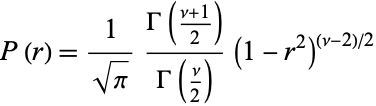
 P(r)=1/(sqrt(pi))(Gamma((nu+1)/2))/(Gamma(nu/2))(1-r^2)^((nu-2)/2)

(27)

as before. See Bevington (1969, pp. 122-123) or Pugh and Winslow (1966, §12-8). If we are interested instead in the probability that a correlation coefficient would be obtained >=|r|, where r is the observed coefficient, then

P_c(r,N) =

(28)

=

(29)

= 1-2/(sqrt(pi))(Gamma((nu+1)/2))/(Gamma(nu/2))int_0^(|r|)(1-r^2)^((nu-2)/2)dr.

(30)

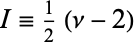
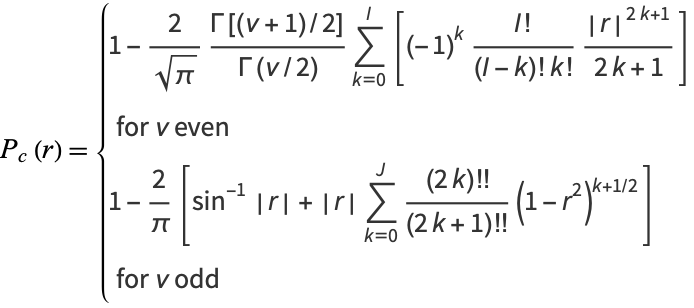
Let I=1/2(nu-2). For even nu, the exponent I is an integer so, by the binomial theorem,
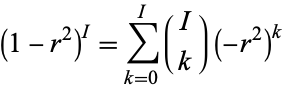
 (1-r^2)^I=sum_(k=0)^I(I; k)(-r^2)^k

(31)

and

P_c(r) =

(32)

=

(33)

For odd nu, the integral is

P_c(r) =

(34)

= 1-2/(sqrt(pi))(Gamma((nu+1)/2))/(Gamma(nu/2))int_0^(|r|)(sqrt(1-r^2))^(nu-2)dr.

(35)

Let r=sinx so dr=cosxdx, then

P_c(r) = 1-2/(sqrt(pi))(Gamma[((nu+1)/2)])/(Gamma(nu/2))int_0^(sin^(-1)|r|)cos^(nu-2)xcosxdx

(36)

= 1-2/(sqrt(pi))(Gamma((nu+1)/2))/(Gamma(nu/2))+int_0^(sin^(-1)|r|)cos^(nu-1)xdx.

(37)

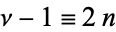
But nu is odd, so nu-1=2n is even. Therefore

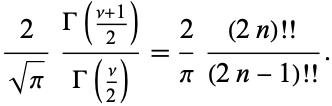
 2/(sqrt(pi))(Gamma((nu+1)/2))/(Gamma(nu/2))=2/pi((2n)!!)/((2n-1)!!).

(38)

Combining with the result from the cosine integral gives

 P_c(r)=1-2/pi((2n)!!(2n-1)!!)/((2n-1)!!(2n)!!)[sinxsum_(k=0)^(n-1)((2k)!!)/((2k+1)!!)cos^(2k+1)x+x]_0^(sin^(-1)|r|).

(39)

Use

 cos^(2k-1)x=(1-r^2)^((2k-1)/2)=(1-r^2)^((k-1/2)),

(40)

and define J=n-1=(nu-3)/2, then

(41)

(In Bevington 1969, this is given incorrectly.) Combining the correct solutions
(42)

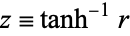
If rho!=0, a skew distribution is obtained, but the variable z defined by

 z=tanh^(-1)r

(43)

is approximately normal with

mu_z = tanh^(-1)rho

(44)

sigma_z^2 = 1/(N-3)

(45)

(Kenney and Keeping 1962, p. 266).

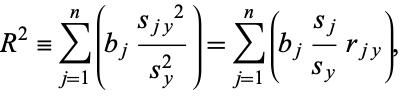
Let b_j be the slope of a best-fit line, then the multiple correlation coefficient is
 R^2=sum_(j=1)^n(b_j(s_(jy)^2)/(s_y^2))=sum_(j=1)^n(b_j(s_j)/(s_y)r_(jy)),

(46)

where s_(jy) is the sample variance.

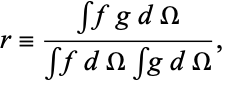
On the surface of a sphere,
 r=(intfgdOmega)/(intfdOmegaintgdOmega),

(47)

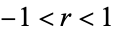
where dOmega is a differential solid angle. This definition guarantees that -1<r<1. If f and g are expanded in real spherical harmonics,
f(theta,phi) = sum_(l=0)^(infty)sum_(m=0)^(l)[C_l^mY_l^m^c(theta,phi)sin(mphi)+S_l^mY_l^m^s(theta,phi)]

(48)

g(theta,phi) = sum_(l=0)^(infty)sum_(m=0)^(l)[A_l^mY_l^m^c(theta,phi)sin(mphi)+B_l^mY_l^m^s(theta,phi)].

(49)

Then

(50)

The confidence levels are then given by

G_1(r) = r

(51)

G_2(r) = r(1+1/2s^2)=1/2r(3-r^2)

(52)

G_3(r) = r[1+1/2s^2(1+3/4s^2)]=1/8r(15-10r^2+3r^4)

(53)

G_4(r) = r<span style={1+1/2s^2[1+3/4s^2(1+5/6s^2)]}" src="https://mathworld.wolfram.com/images/equations/CorrelationCoefficientBivariateNormalDistribution/Inline147.gif" style="height:23px; width:182px" />

(54)

= 1/(16)r(35-35r^2+21r^4-5r^6),

(55)

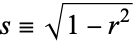
where

 s=sqrt(1-r^2)

(56)

(Eckhardt 1984).


REFERENCES:

Bevington, P. R. Data Reduction and Error Analysis for the Physical Sciences. New York: McGraw-Hill, 1969.

Eckhardt, D. H. "Correlations Between Global Features of Terrestrial Fields." Math. Geology 16, 155-171, 1984.

Kenney, J. F. and Keeping, E. S. Mathematics of Statistics, Pt. 2, 2nd ed. Princeton, NJ: Van Nostrand, 1951.

Kenney, J. F. and Keeping, E. S. Mathematics of Statistics, Pt. 1, 3rd ed. Princeton, NJ: Van Nostrand, 1962.

Pugh, E. M. and Winslow, G. H. The Analysis of Physical Measurements. Reading, MA: Addison-Wesley, 1966.

اخر الاخبار

اشترك بقناتنا على التلجرام ليصلك كل ما هو جديد