Clean Tile Problem
Clean tile is a game investigated by Buffon (1777) in which players bet on the number of different tiles a thrown coin will partially cover on a floor that is regularly tiled. Buffon investigated the probabilities on a triangular grid, square grid, hexagonal grid, and grid composed of rhombi. Assume that the side length of the tile  is greater than the coin diameter
  . Then, on a square grid, it is possible for a coin to land so that it partially covers 1, 2, 3, or 4 tiles. On a triangular grid, it can land on 1, 2, 3, 4, or 6 tiles. On a hexagonal grid, it can land on 1, 2, or 3 tiles.
Special cases of this game give the Buffon-Laplace needle problem (for a square grid) and Buffon's needle problem (for infinite equally spaced parallel lines).
As shown in the figure above, on a square grid with tile edge length  , the probability that a coin of diameter
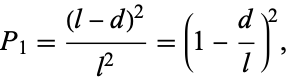
  will lie entirely on a single tile (indicated by yellow disks in the figure) is given by
 |
(1)
|
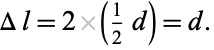
since the shortening of the side of a square obtained by insetting from a square of side length  by the radius of the coin
  is given by
 |
(2)
|
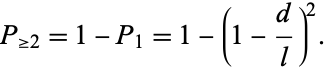
The probability that it will lie on two or more (indicated by red disks) is just
 |
(3)
|
For the game to be fair with two players betting on (1) a single tile or (2) two or more tiles, these quantities must be equal, which gives
 |
(4)
|
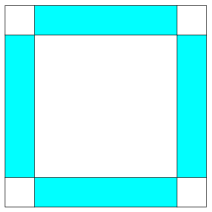
The probability of landing on exactly two tiles is the ratio of shaded area in the above figure to the tile size, namely
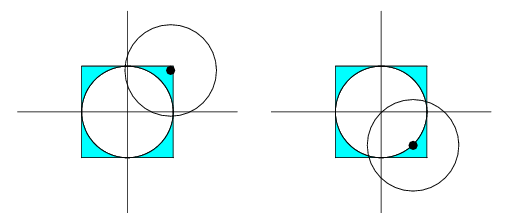
On a square grid, the probability of a coin landing on exactly three tiles is the fraction of a tile covered by the region illustrated in the figure above,
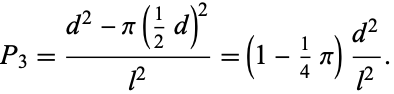 |
(7)
|
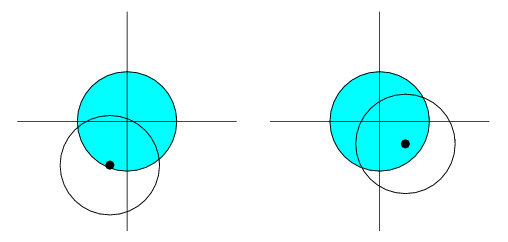
Similarly, the probability of a coin landing on four tiles is the fraction of a tile covered by a disk, as illustrated in the figure above,
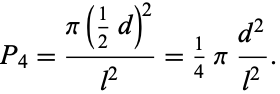 |
(8)
|
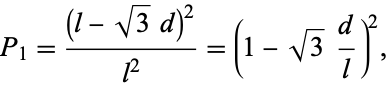
As shown in the figure above, on a triangular grid with tile edge length  , the probability that a coin of diameter
  will lie entirely on a single tile is given by
 |
(9)
|
since the shortening of the side of an equilateral triangle obtained by insetting from a triangle of side length  by the radius of the coin
  is
is
 |
(10)
|
The probability that it will lie on two or more is just
 |
(11)
|
For the game to be fair with two players betting on (1) a single tile or (2) two or more tiles, these quantities must be equal, which gives
 |
(12)
|
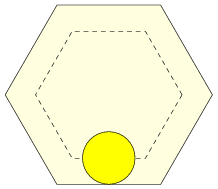
As shown in the figure above, on a hexagonal grid with tile edge length  , the probability that a coin of diameter
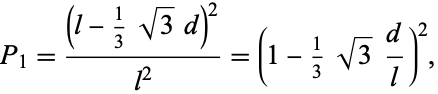
  will lie entirely on a single tile is given by
 |
(13)
|
since the shortening of the side of a regular hexagon obtained by insetting from a triangle of side length  by the radius of the coin
  is
is
 |
(14)
|
The probability that it will lie on two or more is just
 |
(15)
|
For the game to be fair with two players betting on (1) a single tile or (2) two or more tiles, these quantities must be equal, which gives
 |
(16)
|
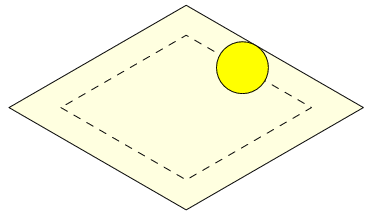
In a quadrilateral tiling formed by rhombi with opening angle  , insetting from a rhombus of side length
  gives
gives
so
 |
(19)
|
Therefore, the probability that a coin will lie on a single tile is
The probability that it will lie on two or more is just
 |
(22)
|
For the game to be fair with two players betting on (1) a single tile or (2) two or more tiles, these quantities must be equal, which gives
 |
(23)
|
As expected, this reduces to the square case for  .
.
REFERENCES:
Buffon, G. "Essai d'arithmétique morale." Histoire naturelle, générale er particulière, Supplément 4, 46-123, 1777.
Mathai, A. M. "The Clean Tile Problem." §1.1.1 in An Introduction to Geometrical Probability: Distributional Aspects with Applications. Taylor & Francis: pp. 2-5, 1999.
Solomon, H. Geometric Probability. Philadelphia, PA: SIAM, 1978.








