Hawkes Process
There are a number of point processes which are called Hawkes processes and while many of these notions are similar, some are rather different. There are also different formulations for univariate and multivariate point processes.
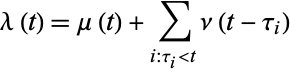
In some literature, a univariate Hawkes process is defined to be a self-exciting temporal point process  whose conditional intensity function
  is defined to be
 |
(1)
|
where  is the background rate of the process
  , where
  are the points in time occurring prior to time
  , and where
  is a function which governs the clustering density of
  . The function
  is sometimes called the exciting function or the excitation function of
  . Similarly, some authors (Merhdad and Zhu 2014) denote the conditional intensity function
  by
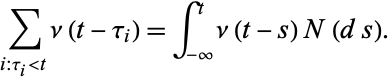
by  and rewrite the summand in () as
 |
(2)
|
The processes upon which Hawkes himself made the most progress were univariate self-exciting temporal point processes  whose conditional intensity function
  is linear (Hawkes 1971). As a result, some authors refer to such processes as Hawkes processes. In general, however, such
  behavior is typically specified, i.e., processes for which
  is linear are referred to as linear Hawkes processes and are differentiated from their non-linear counterparts whose conditional intensity functions
  are non-linear (Merhdad and Zhu 2014).
Still other authors consider two alternative brands of univariate Hawkes processes, one the so-called intensity-based Hawkes process and the other the so-called cluster-based version, which are equivalent though are studied in different contexts (Dassios and Zhao 2013). In this case, the intensity-based process is a temporal point process ![N_t=<span style=]() {tau_i}_(i=1,2,...)" src="https://mathworld.wolfram.com/images/equations/HawkesProcess/Inline18.gif" style="height:18px; width:88px" /> on
{tau_i}_(i=1,2,...)" src="https://mathworld.wolfram.com/images/equations/HawkesProcess/Inline18.gif" style="height:18px; width:88px" /> on  which has a nonnegative exponentially-decaying
  -stochastic intensity
  of the form
 |
(3)
|
for  , where
 ![<span style=]() {F_t}_(t>=0)" src="https://mathworld.wolfram.com/images/equations/HawkesProcess/Inline23.gif" style="height:15px; width:38px" /> is a history of the process
{F_t}_(t>=0)" src="https://mathworld.wolfram.com/images/equations/HawkesProcess/Inline23.gif" style="height:15px; width:38px" /> is a history of the process  with respect to which
 ![<span style=]() {lambda_t}_(t>=0)" src="https://mathworld.wolfram.com/images/equations/HawkesProcess/Inline25.gif" style="height:15px; width:36px" /> is adapted,
{lambda_t}_(t>=0)" src="https://mathworld.wolfram.com/images/equations/HawkesProcess/Inline25.gif" style="height:15px; width:36px" /> is adapted,  is the constant reversion level,
  is the initial intensity at time
  ,
,  is the constant rate of exponential decay,
 ![<span style=]() {Y_i}_(i=1,2,...)" src="https://mathworld.wolfram.com/images/equations/HawkesProcess/Inline30.gif" style="height:18px; width:57px" /> are the sizes of the self-excited jumps viewed as independent random variables distributed according to some distribution function
{Y_i}_(i=1,2,...)" src="https://mathworld.wolfram.com/images/equations/HawkesProcess/Inline30.gif" style="height:18px; width:57px" /> are the sizes of the self-excited jumps viewed as independent random variables distributed according to some distribution function  ,
,  , and
, and ![<span style=]() {tau_i}" src="https://mathworld.wolfram.com/images/equations/HawkesProcess/Inline33.gif" style="height:15px; width:21px" /> and
{tau_i}" src="https://mathworld.wolfram.com/images/equations/HawkesProcess/Inline33.gif" style="height:15px; width:21px" /> and ![<span style=]() {Y_i}" src="https://mathworld.wolfram.com/images/equations/HawkesProcess/Inline34.gif" style="height:15px; width:21px" /> are assumed to be independent of one another. This is equivalent to the cluster-based version in which () is viewed as a marked Poisson cluster process
{Y_i}" src="https://mathworld.wolfram.com/images/equations/HawkesProcess/Inline34.gif" style="height:15px; width:21px" /> are assumed to be independent of one another. This is equivalent to the cluster-based version in which () is viewed as a marked Poisson cluster process ![C=<span style=]() {(tau_i,Y_i)}_(i=1,2,...)" src="https://mathworld.wolfram.com/images/equations/HawkesProcess/Inline35.gif" style="height:18px; width:111px" />, the only difference being that from the cluster-based perspective:
{(tau_i,Y_i)}_(i=1,2,...)" src="https://mathworld.wolfram.com/images/equations/HawkesProcess/Inline35.gif" style="height:18px; width:111px" />, the only difference being that from the cluster-based perspective:
1. The set ![I=<span style=]() {tau_i} subset R^+" src="https://mathworld.wolfram.com/images/equations/HawkesProcess/Inline36.gif" style="height:15px; width:76px" /> consists of elements known as immigrants which are distributed as an inhomogeneous Poisson process with rate
{tau_i} subset R^+" src="https://mathworld.wolfram.com/images/equations/HawkesProcess/Inline36.gif" style="height:15px; width:76px" /> consists of elements known as immigrants which are distributed as an inhomogeneous Poisson process with rate
 |
(4)
|
for  .
.
2. The set ![<span style=]() {Y_i}" src="https://mathworld.wolfram.com/images/equations/HawkesProcess/Inline38.gif" style="height:15px; width:21px" /> of marks associated to the immigrants
{Y_i}" src="https://mathworld.wolfram.com/images/equations/HawkesProcess/Inline38.gif" style="height:15px; width:21px" /> of marks associated to the immigrants  are independent of the immigrants and are distributed as independent random variables according to some distribution
  .
.
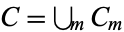
3. Each immigrant  generates a single cluster
  independent of other clusters where here, each
  is viewed as a random set subject to a certain branching structure (Dassios and Zhao 2013) which satisfies the property that
  .
.
In addition to these ambiguities, several authors (e.g., Merhdad and Zhu 2014), have made generalized versions of the univariate process described in () which are still referred to as Hawkes processes. One example includes adapting () so that the process has different exciting functions, the result of which is a collection  of non-explosive simple point processes for which:
1.  is an inhomogeneous Poisson process with intensity
  at time
  ;
;
2. For every  ,
,  is a simple point process with intensity
 |
(5)
|
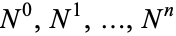
3. For every ![n in <span style=]() {0,1,2,...}" src="https://mathworld.wolfram.com/images/equations/HawkesProcess/Inline51.gif" style="height:15px; width:91px" />,
{0,1,2,...}" src="https://mathworld.wolfram.com/images/equations/HawkesProcess/Inline51.gif" style="height:15px; width:91px" />,  is an inhomogeneous Poisson process with intensity
  conditional on
  .
.
In this context, the function 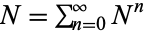 is said to be a univariate Hawkes process with excitation functions
 ![(gamma_n)_(n in <span style=]() {0,1,2,...})" src="https://mathworld.wolfram.com/images/equations/HawkesProcess/Inline56.gif" style="height:18px; width:71px" /> while
{0,1,2,...})" src="https://mathworld.wolfram.com/images/equations/HawkesProcess/Inline56.gif" style="height:18px; width:71px" /> while  is called the immigrant process and
  the
the  th generation offspring process (Merhdad and Zhu 2014). Note that when
  and when
  for any
  , this extended model reduces to the classical linear model ().
Due to the vast usage of the term Hawkes process among univariate point processes, one expects there to be room for an equally large number of definitions of multivariate Hawkes processes. Surprisingly, however, the most common use of the term is assigned to a relatively straightforward extension of equations () and (), whereby one says that a multivariate  -dimensional counting process
  taking values in
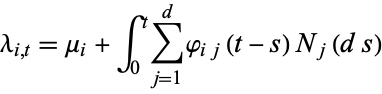
  is a multivariate Hawkes process whenever the associated intensity function
 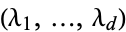 defined by
![lambda_(i,t)dt=P(N_i has a jump in [t,t+dt]|F_t),](https://mathworld.wolfram.com/images/equations/HawkesProcess/NumberedEquation6.gif) |
(6)
|
for  , ...,
  has the form
 |
(7)
|
(Bacry et al. 2012). Here,  stands for probability,
  is the sigma-algebra generated by
  up to present time
  ,
,  , and
, and 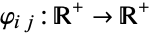 for
for 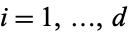 .
.
It is worth noting, however, that precisely as with the univariate case, some authors distinguish between different "types" of multivariate Hawkes processes (Liniger 2009) while other authors define completely separate types of multivariate functions to be multivariate Hawkes processes (Carlsson et al. 2007).
REFERENCES:
Bacry, E.; Delattre, S.; Hoffmann, M.; and Muzy, J. F. "Scaling Limits for Hawkes Processes and Applications to Financial Statistics." 2012. https://arxiv.org/abs/1202.0842v1.
Carlsson, J.; Foo, M. C.; Lee, H. H.; and Shek, H. "High Frequency Trade Prediction with Bivariate Hawkes Process." 2007. https://users.iems.northwestern.edu/~armbruster/2007msande444/report1b.pdf.
Dassios, A. and Zhao, H. "Exact Simulation of Hawkes Process with Exponentially Decaying Intensity." Electron. Commun. Probab. 18, 1-13, 2013.
Hawkes, A. G. "Spectra of Some Self-Exciting and Mutually Exciting Point Processes." Biometrika 58, 83-90, 1971.
Hawkes, A. G. and Oakes, D. "A Cluster Process Representation of a Self-Exciting Process." J. Appl. Prob. 11, 493-503, 1974.
Hawkes, A. G. and Adamopoulos, L. "Cluster Models for Earthquakes: Regional Comparisons." Bull. Int. Statist. Inst. 45, 454-461, 1973.
Liniger, T. "Multivariate Hawkes Processes." 2009.
Mehrdad, B. and Zhu, L. "On the Hawkes Process with Different Exciting Functions." 2014. https://arxiv.org/abs/1403.0994v1.








