Charlier's Check
A check which can be used to verify correct computations in a table of grouped classes. For example, consider the following table with specified class limits and frequencies  . The class marks
  are then computed as well as the rescaled frequencies
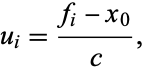
  , which are given by
 |
(1)
|
where the class mark is taken as 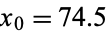 and the class interval is
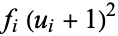
  . The remaining quantities are then computed as follows.
| class limits |
 |
 |
 |
 |
 |
 |
| 30-39 |
34.5 |
2 |
 |
 |
32 |
18 |
| 40-49 |
44.5 |
3 |
 |
 |
27 |
12 |
| 50-59 |
54.5 |
11 |
 |
 |
44 |
11 |
| 60-69 |
64.5 |
20 |
 |
 |
20 |
0 |
| 70-79 |
74.5 |
32 |
0 |
0 |
0 |
32 |
| 80-89 |
84.5 |
25 |
1 |
25 |
25 |
100 |
| 90-99 |
94.5 |
7 |
2 |
14 |
28 |
63 |
| total |
|
100 |
|
 |
176 |
236 |
In order to compute the variance, note that
so the variance of the original data is
 |
(5)
|
Charlier's check makes use of the additional column 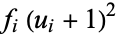 added to the right side of the table. By noting that the identity
connects columns five through seven, it can be checked that the computations have been done correctly. In the example above,
 |
(8)
|
so the computations pass Charlier's check.
REFERENCES:
Kenney, J. F. and Keeping, E. S. "Charlier Check." §6.8 in Mathematics of Statistics, Pt. 1, 3rd ed. Princeton, NJ: Van Nostrand, pp. 47-48, 81, 94-95, and 104, 1962.








