Eban Number
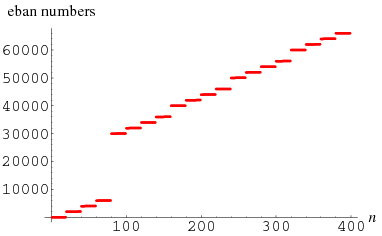
The eban numbers are the sequence of numbers whose names (in English) do not contain the letter "e" (i.e., "e" is "banned"). The name was coined by N. J. A. Sloane around 1990. Note that this definition is imprecise insofar as special names are sometimes assigned to a few large numbers that do not follow the usual rules for the naming of such numbers.
The first few eban numbers are 2, 4, 6, 30, 32, 34, 36, 40, 42, 44, 46, 50, 52, 54, 56, 60, 62, 64, 66, 2000, 2002, 2004, ... (OEIS A006933); i.e., two, four, six, thirty, etc. These exclude one, three, five, seven, eight, nine, ten, eleven, twelve, etc.
In English, every odd number contains an "e," so all eban numbers are even (Hernandez et al. 2002-2003). In addition, eban numbers satisfy the following properties (Hernandez et al. 2002-2003).
1. There are gaps larger than any given number between eban numbers.
2. If a number of the form  is an eban number, then
 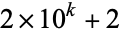 is also an eban number for any nonnegative integer
  .
.
3. Let an "ebanie" be defined as 0 or one of the eban numbers 2, 4, 6, 30, 32, 34, 36, 40, 42, 44, 46, 50, 52, 54, 56, 60, 62, 64, or 66, and let an almost eban power be a power of 10 whose name contains exactly one "e." Then all eban numbers have the form 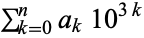 , where
  are ebanies that are not all zero and
  are almost eban powers.

A plot of the first few eban numbers represented as a sequence of binary bits is shown above. The top portion shows  to
to  , and the bottom shows the next 510 values.
REFERENCES:
Hernandez, J. C.; Mex-Perera, C.; and Shepherd, S. J. "Characterization of Eban Numbers." J. Recr. Math. 31, 197-200, 2002-2003.
Sloane, N. J. A. Sequence A006933/M1030 in "The On-Line Encyclopedia of Integer Sequences."








