Constructible Number
A number which can be represented by a finite number of additions, subtractions, multiplications, divisions, and finite square root extractions of integers. Such numbers correspond to line segments which can be constructed using only straightedge and compass.
All rational numbers are constructible, and all constructible numbers are algebraic numbers (Courant and Robbins 1996, p. 133). If a cubic equation with rational coefficients has no rational root, then none of its roots is constructible (Courant and Robbins 1996, p. 136).
In particular, let  be the field of rationals. Now construct an extension field
  of constructible numbers by the adjunction of
  , where
  is in
is in  , but
, but  is not, consisting of all numbers of the form
 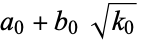 , where
 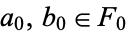 . Next, construct an extension field
  of
of  by the adjunction of
  , defined as the numbers
 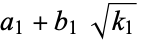 , where
 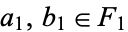 , and
, and  is a number in
  for which
  does not lie in
  . Continue the process
  times. Then constructible numbers are precisely those which can be reached by such a sequence of extension fields
  , where
  is a measure of the "complexity" of the construction (Courant and Robbins 1996).
REFERENCES:
Bold, B. "Achievement of the Ancient Greeks" and "An Analytic Criterion for Contractibility." Chs. 1-2 in Famous Problems of Geometry and How to Solve Them. New York: Dover, pp. 1-17, 1982.
Courant, R. and Robbins, H. "Constructible Numbers and Number Fields." §3.2 in What Is Mathematics?: An Elementary Approach to Ideas and Methods, 2nd ed. Oxford, England: Oxford University Press, pp. 127-134, 1996.








