Landau-Ramanujan Constant
Let  denote the number of positive integers not exceeding
  which can be expressed as a sum of two squares (i.e., those
  such that the sum of squares function
  ). For example, the first few positive integers that can be expressed as a sum of squares are
(OEIS A001481), so  ,
,  ,
,  ,
,  ,
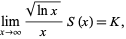
,  , and so on. Then
 |
(6)
|
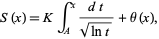
as proved by Landau (1908), where  is a constant. Ramanujan independently stated the theorem in the slightly different form that the number of numbers between
  and
and  which are either squares of sums of two squares is
 |
(7)
|
where  and
and  is very small compared with the previous integral (Berndt and Rankin 1995, p. 24; Hardy 1999, p. 8; Moree and Cazaran 1999).
Note that for  ,
,  iff
iff  is not divisible by a prime power
  with
with  and
and  odd.
odd.
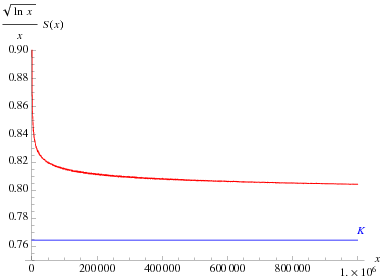
The constant has numerical value
 |
(8)
|
(OEIS A064533). However, the convergence to the constant  , known as the Landau-Ramanujan constant and sometimes also denoted
  , is very slow. The following table summarizes the values of the left side of equation (7) for the first few powers of 10, where the sequence of
  is (OEIS A164775).
 |
 |
 |
 |
7 |
1.062199 |
 |
43 |
0.922765 |
 |
330 |
0.867326 |
 |
2749 |
0.834281 |
 |
24028 |
0.815287 |
 |
216341 |
0.804123 |
 |
1985459 |
0.797109 |
 |
18457847 |
0.792198 |
 |
173229058 |
0.788587 |
 |
1637624156 |
0.785818 |
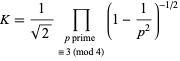
An exact formula for the constant is given by
 |
(9)
|
(Landau 1908; Le Lionnais 1983, p. 31; Berndt 1994; Hardy 1999; Moree and Cazaran 1999), and an equivalent formula is given by
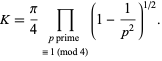 |
(10)
|
Flajolet and Vardi (1996) give a beautiful formula with fast convergence
![K=1/(sqrt(2))product_(n=1)^infty[(1-1/(2^(2^n)))(zeta(2^n))/(beta(2^n))]^(1/2^(n+1)),](https://mathworld.wolfram.com/images/equations/Landau-RamanujanConstant/NumberedEquation6.gif) |
(11)
|
where  is the Dirichlet beta function.
Another closed form is
![K=lim_(n->infty)(sqrt(lnn))/nsum_(k=1)^n[1-delta_(0,r_2(k))],](https://mathworld.wolfram.com/images/equations/Landau-RamanujanConstant/NumberedEquation7.gif) |
(12)
|
where  is the Kronecker delta and
  is the sum of squares Function.
W. Gosper used the related formula
![K=1/2[1/(Psi(2)-1)]^(sqrt(2))product_(k=2)^infty[1/(-Psi(2^k)-1)]^(1/(2^(k+1))),](https://mathworld.wolfram.com/images/equations/Landau-RamanujanConstant/NumberedEquation8.gif) |
(13)
|
where
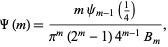 |
(14)
|
where  is a Bernoulli number and
  is a polygamma function (Finch 2003).
Landau also proved the even stronger fact
![lim_(x->infty)((lnx)^(3/2))/(Kx)[S(x)-(Kx)/(sqrt(lnx))]=C,](https://mathworld.wolfram.com/images/equations/Landau-RamanujanConstant/NumberedEquation10.gif) |
(15)
|
where
(OEIS A085990), e is the base of the natural logarithm,  is the Euler-Mascheroni constant, and
  is the lemniscate constant.
Landau's method of proof can be extended to show that
 |
(18)
|
has an asymptotic series
![S(x)=Kx/(sqrt(lnx))[1+(c_1)/(lnx)+(c_2)/((lnx)^2)+...+(c_n)/((lnx)^n)+O(1/((lnx)^(n+1)))],](https://mathworld.wolfram.com/images/equations/Landau-RamanujanConstant/NumberedEquation12.gif) |
(19)
|
where  can be arbitrarily large and the
  are constants with
  (Moree and Cazaran 1999).
REFERENCES:
Berndt, B. C. Ramanujan's Notebooks, Part IV. New York: Springer-Verlag, pp. 60-66, 1994.
Berndt, B. C. and Rankin, R. A. Ramanujan: Letters and Commentary. Providence, RI: Amer. Math. Soc., pp. 25, 47, and 49, 1995.
Finch, S. R. "Landau-Ramanujan Constant." §2.3 in Mathematical Constants. Cambridge, England: Cambridge University Press, pp. 98-104, 2003.
Flajolet, P. and Vardi, I. "Zeta Function Expansions of Classical Constants." Unpublished manuscript. 1996. https://algo.inria.fr/flajolet/Publications/landau.ps.
Hardy, G. H. Ramanujan: Twelve Lectures on Subjects Suggested by His Life and Work, 3rd ed. New York: Chelsea, pp. 9-10, 55, and 60-64, 1999.
Landau, E. "Über die Einteilung der positiven ganzen Zahlen in vier Klassen nach der Mindeszahl der zu ihrer additiven Zusammensetzung erforderlichen Quadrate." Arch. Math. Phys. 13, 305-312, 1908.
Landau, E. Handbuch der Lehre von der Verteilung der Primzahlen, Bd. II, 2nd ed. New York: Chelsea, pp. 641-669, 1953.
Le Lionnais, F. Les nombres remarquables. Paris: Hermann, 1983.
Moree, P. and Cazaran, J. "On a Claim of Ramanujan in His First Letter to Hardy." Expos. Math. 17, 289-312, 1999.
Selberg, A. Collected Papers, Vol. 2. Berlin: Springer-Verlag, pp. 183-185, 1991.
Shanks, D. "The Second-Order Term in the Asymptotic Expansion of  ." Math. Comput. 18, 75-86, 1964.
Shanks, D. "Non-Hypotenuse Numbers." Fibonacci Quart. 13, 319-321, 1975.
Shanks, D. and Schmid, L. P. "Variations on a Theorem of Landau. I." Math. Comput. 20, 551-569, 1966.
Shiu, P. "Counting Sums of Two Squares: The Meissel-Lehmer Method." Math. Comput. 47, 351-360, 1986.
Sloane, N. J. A. Sequences A001481/M0968, A064533, A085990, and A164775 in "The On-Line Encyclopedia of Integer Sequences."
Stanley, G. K. "Two Assertions Made by Ramanujan." J. London Math. Soc. 3, 232-237, 1928.
Stanley, G. K. Corrigendum to "Two Assertions Made by Ramanujan." J. London Math. Soc. 4, 32, 1929.
Wolfram Research, Inc. "Computing the Landau-Ramanujan Constant." https://library.wolfram.com/infocenter/Demos/120/.








