Evil Number
A number  in which the first
  decimal digits of the fractional part
  sum to 666 is known as an evil number (Pegg and Lomont 2004).

However, the term "evil" is also used to denote nonnegative integers that have an even number of 1s in their binary expansions, the first few of which are 0, 3, 5, 6, 9, 10, 12, 15, 17, 18, 20, ... (OEIS A001969), illustrated above as a binary plot. Numbers that are not evil are then known as odious numbers.
Returning to Pegg's definition of evil, the fact that  is evil was noted by Keith, while I. Honig (pers. comm., May 9, 2004) noted that the golden ratio
  is also evil. The following table gives a list of some common evil numbers (Pegg and Lomont 2004).
 |
 |
Ramanujan constant  |
132 |
hard hexagon entropy constant  |
137 |
 |
139 |
 |
140 |
Stieltjes constant  |
142 |
pi  |
144 |
golden ratio  |
146 |
 |
146 |
 |
151 |
Glaisher-Kinkelin constant  |
153 |
| cube line picking average length |
155 |
Delian constant  |
156 |
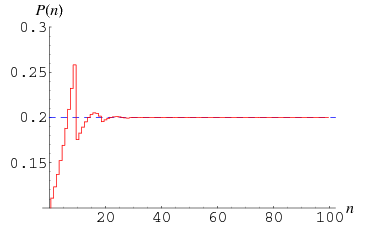
The probability of the digits of a given real number summing to a relatively large positive integer is roughly given by the number of nonzero digits divided by sum of those digits, namely  . Amazingly, the exact probability for summing to a number
  can be computed exactly using the recursive formulas
For  , 2, ..., the first few values are therefore 1/9, 10/81, 100/739, 1000/6561, ... (OEIS A100061 and A100062; Pegg and Lomont 2004), plotted above.
The generating function for this series is given by
 |
(3)
|
(Pegg and Lomont 2004). This allows an expression for  to be determined in closed form, although it is a complicated expression involving combinations of the algebraic numbers (and polynomial roots)
  .
.
For the case of interest ( ), the result is a rational number having a 635-digit numerator and a 636-digit denominator that is approximately equal to
 |
(4)
|
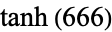
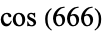
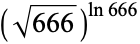
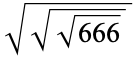
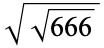
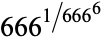
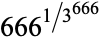
A set of "beastly evil" numbers are given by the following (M. Hudson, pers. comm., Nov 5-10, 2004).
| number |
digits |
 |
74 |
 |
74 |
 |
136 |
 |
142 |
 |
146 |
 |
147 |
 |
149 |
 |
152 |
 |
156 |
 |
159 |
 |
163 |
 |
468 |
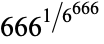 |
655 |
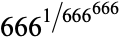 |
2018 |
Powers of  that are evil include
  , 6, 8, 10, 17, 18, 24, 25, 26, 29, 30, 38, ... (M. Hudson, pers. comm., Nov. 8, 2004).
The analogous problem of terms in a simple continued fraction summing to a given number can also be considered. The following table summarized some constants whose continued fractions have cumulative sums that equal 666 (Pegg and Lomont 2004).
| constant |
terms |
| cube line picking average length |
50 |
pi  |
56 |
| Bloch constant |
58 |
| Gauss's constant |
143 |
 |
167 |
| conjectured value of Landau constant |
173 |
Interestingly, this makes the cube line picking average length and  doubly evil.
REFERENCES:
Keith, M. "The Number of the Beast." https://users.aol.com/s6sj7gt/mike666.htm.
Pegg, E. Jr. and Lomont, C. "Math Games: Evil Numbers." Oct. 4, 2004. https://www.maa.org/editorial/mathgames/mathgames_10_04_04.html.
Sloane, N. J. A. Sequences A001969, A100061 and A100062 in "The On-Line Encyclopedia of Integer Sequences."








