Least Prime Factor
Let  be any integer and let
  (also denoted
  ) be the least integer greater than 1 that divides
  , i.e., the number
  in the factorization
with  for
for  . The least prime factor is implemented in the Wolfram Language as FactorInteger[n][[1,1]].
For  , 3, ..., the first few are 2, 3, 2, 5, 2, 7, 2, 3, 2, 11, 2, 13, 2, 3, ... (OEIS A020639).
If  is composite then
 ![[lpf(n)]^2<=n](https://mathworld.wolfram.com/images/equations/LeastPrimeFactor/Inline10.gif) (Séroul 2000, p. 7), with equality for
(Séroul 2000, p. 7), with equality for  the square of a prime.
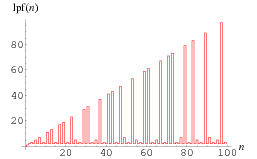
A plot of the least prime factor function resembles a jagged terrain of mountains, which leads to the appellation of "twin peaks" to a pair of integers  such that
1.  ,
,
2.  ,
,
3. For all  ,
,  implies
  .
.
The least multiple prime factors for squareful integers are 2, 2, 3, 2, 2, 3, 2, 2, 5, 3, 2, 2, 2, ... (OEIS A046027).
Erdős et al. (1993) consider the least prime factor of the binomial coefficients, and define what they term good binomial coefficients and exceptional binomial coefficients. They also conjecture that
REFERENCES:
Erdős, P.; Lacampagne, C. B.; and Selfridge, J. L. "Estimates of the Least Prime Factor of a Binomial Coefficient." Math. Comput. 61, 215-224, 1993.
Séroul, R. "The Lowest Divisor Function." §8.4 in Programming for Mathematicians. Berlin: Springer-Verlag, pp. 9-11 and 165-167, 2000.
Sloane, N. J. A. Sequences A020639 and A046027 in "The On-Line Encyclopedia of Integer Sequences."








