Weak Law of Large Numbers
The weak law of large numbers (cf. the strong law of large numbers) is a result in probability theory also known as Bernoulli's theorem. Let  , ...,
  be a sequence of independent and identically distributed random variables, each having a mean
  and standard deviation
  . Define a new variable
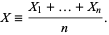 |
(1)
|
Then, as  , the sample mean
  equals the population mean
  of each variable.
In addition,
Therefore, by the Chebyshev inequality, for all  ,
,
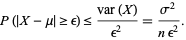 |
(10)
|
As  , it then follows that
 |
(11)
|
(Khinchin 1929). Stated another way, the probability that the average  for
for  an arbitrary positive quantity approaches 1 as
  (Feller 1968, pp. 228-229).
REFERENCES:
Feller, W. "Laws of Large Numbers." Ch. 10 in An Introduction to Probability Theory and Its Applications, Vol. 1, 3rd ed. New York: Wiley, pp. 228-247, 1968.
Feller, W. "Law of Large Numbers for Identically Distributed Variables." §7.7 in An Introduction to Probability Theory and Its Applications, Vol. 2, 3rd ed. New York: Wiley, pp. 231-234, 1971.
Khinchin, A. "Sur la loi des grands nombres." Comptes rendus de l'Académie des Sciences 189, 477-479, 1929.
Papoulis, A. Probability, Random Variables, and Stochastic Processes, 2nd ed. New York: McGraw-Hill, pp. 69-71, 1984.








