Gauss-Kuzmin-Wirsing Constant
Wirsing (1974) showed, among other results, that if  is the Gauss-Kuzmin distribution, then
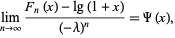 |
(1)
|
where  (OEIS A038517; Knuth 1998, p. 350) and
  is an analytic function with
  .
.
 was computed to about 30 decimal places by Flajolet and Vallée (1995) and to 100 places by Sebah (unpublished). Briggs (2003) computed
  as the negative of the second largest (in absolute value) eigenvalue of the
  matrix defined by
![M_(jk)=((-1)^j)/(j!(-2)^k)sum_(i=0)^k(k; i)(-2)^i(i+2)_j[zeta(i+j+2)(2^(i+j+2)-1)-2^(i+j+2)]](https://mathworld.wolfram.com/images/equations/Gauss-Kuzmin-WirsingConstant/NumberedEquation2.gif) |
(2)
|
for  , where
  is a binomial coefficient,
  is a Pochhammer symbol, and
  is the Riemann zeta function. For example,
![M_2=[1/2(pi^2-8) 7zeta(3)-1/4pi^2-6; 16-14zeta(3) 7zeta(3)-1/2pi^4+40].](https://mathworld.wolfram.com/images/equations/Gauss-Kuzmin-WirsingConstant/NumberedEquation3.gif) |
(3)
|
Briggs (2003) used  and a precision of 1300 bits to obtain 385 digits.
This constant is connected to the efficiency of the Euclidean algorithm. It has continued fraction [0, 3, 3, 2, 2, 3, 13, 1, 174, ...] (OEIS A007515; Knuth 1998, p. 350).
REFERENCES:
Babenko, K. I. "On a Problem of Gauss." Soviet Math. Dokl. 19, 136-140, 1978.
Bailey, D. H.; Borwein, J. M.; and Crandall, R. E. "On the Khintchine Constant." Math. Comput. 66, 417-431, 1997.
Briggs, K. "A Precise Computation of the Gauss-Kuzmin-Wirsing Constant." Preliminary report. 2003 July 8. https://keithbriggs.info/documents/wirsing.pdf.
Daudé, H.; Flajolet, P.; and Vallé, B. "An Average-Case Analysis of the Gaussian Algorithm for Lattice Reduction." Combin. Probab. Comput. 6, 397-433, 1997.
Finch, S. R. "Gauss-Kuzmin-Wirsing Constant." §2.17 in Mathematical Constants. Cambridge, England: Cambridge University Press, pp. 151-156, 2003.
Flajolet, P. and Vallée, B. "On the Gauss-Kuzmin-Wirsing Constant." Unpublished memo. 1995. https://algo.inria.fr/flajolet/Publications/gauss-kuzmin.ps.
Knuth, D. E. The Art of Computer Programming, Vol. 2: Seminumerical Algorithms, 3rd ed. Reading, MA: Addison-Wesley, p. 341, 1998.
MacLeod, A. J. "High-Accuracy Numerical Values of the Gauss-Kuzmin Continued Fraction Problem." Computers Math. Appl. 26, 37-44, 1993.
Mayer, D. H. "Continued Fractions and Related Transformations." In Ergodic Theory, Symbolic Dynamics and Hyperbolic Spaces. Papers from the Workshop on Hyperbolic Geometry and Ergodic Theory held in Trieste, April 17-28, 1989 (Ed. T. Bedford, M. Keane, and C. Series). New York: Clarendon Press, pp. 175-222, 1991.
Plouffe, S. "The Gauss-Kuzmin-Wirsing Constant." https://pi.lacim.uqam.ca/piDATA/gkw.txt.
Sloane, N. J. A. Sequences A007515/M2267 and A038517 in "The On-Line Encyclopedia of Integer Sequences."
Wirsing, E. "On the Theorem of Gauss-Kuzmin-Lévy and a Frobenius-Type Theorem for Function Spaces." Acta Arith. 24, 507-528, 1974.








