Hanning Function
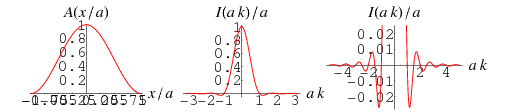
An apodization function, also called the Hann function, frequently used to reduce leakage in discrete Fourier transforms. The illustrations above show the Hanning function, its instrument function, and a blowup of the instrument function sidelobes. It is named after the Austrian meteorologist Julius von Hann (Blackman and Tukey 1959, pp. 98-99). The Hanning function is given by
Its full width at half maximum is  .
.
It has instrument function
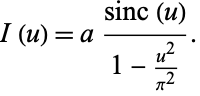
To investigate the instrument function, define the dimensionless parameter 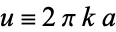 and rewrite the instrument function as
 |
(5)
|
The half-maximum can then be seen to occur at
 |
(6)
|
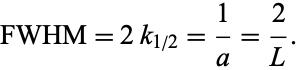
so for  , the full width at half maximum is
 |
(7)
|
To find the extrema, take the derivative
 |
(8)
|
and equate to zero. The first two roots are  and 10.7061..., corresponding to the first sidelobe minimum (
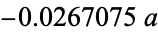 ) and maximum (
 ), respectively.
REFERENCES:
Blackman, R. B. and Tukey, J. W. "Particular Pairs of Windows." §B.5 in The Measurement of Power Spectra, From the Point of View of Communications Engineering. New York: Dover, pp. 14-15 and 95-100, 1959.
Press, W. H.; Flannery, B. P.; Teukolsky, S. A.; and Vetterling, W. T. Numerical Recipes in FORTRAN: The Art of Scientific Computing, 2nd ed. Cambridge, England: Cambridge University Press, pp. 554-556, 1992.








