Hamming Function
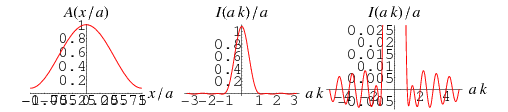
An apodization function chosen to minimize the height of the highest sidelobe (Hamming and Tukey 1949, Blackman and Tukey 1959). The Hamming function is given by
 |
(1)
|
and its full width at half maximum is 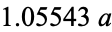 .
.
The corresponding instrument function is
 |
(2)
|
This apodization function is close to the one produced by the requirement that the instrument function goes to 0 at 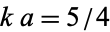 . The FWHM is
 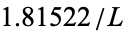 , the peak is 1.08, and the peak negative and positive sidelobes (in units of the peak) are
 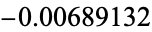 and 0.00734934, respectively.
From the apodization function, a general symmetric apodization function  can be written as a Fourier series
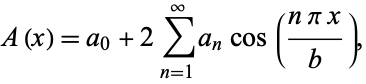 |
(3)
|
where the coefficients satisfy
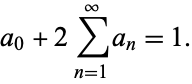 |
(4)
|
The corresponding instrument function is
![I(t)=2b<span style=]() {a_0sinc(2pikb)+sum_(n=1)^infty[sinc(2pikb+npi)+sinc(2pikb-npi)]}. " src="https://mathworld.wolfram.com/images/equations/HammingFunction/NumberedEquation5.gif" style="height:45px; width:431px" /> {a_0sinc(2pikb)+sum_(n=1)^infty[sinc(2pikb+npi)+sinc(2pikb-npi)]}. " src="https://mathworld.wolfram.com/images/equations/HammingFunction/NumberedEquation5.gif" style="height:45px; width:431px" /> |
(5)
|
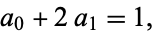
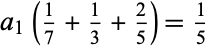
To obtain an apodization function with zero at 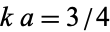 , use
, use
 |
(6)
|
so
 |
(7)
|
 |
(8)
|
 |
(9)
|
REFERENCES:
Blackman, R. B. and Tukey, J. W. "Particular Pairs of Windows." In The Measurement of Power Spectra, From the Point of View of Communications Engineering. New York: Dover, pp. 98-99, 1959.
Hamming, R. W. and Tukey, J. W. "Measuring Noise Color." Unpublished memorandum, 1949.








