Gram Point
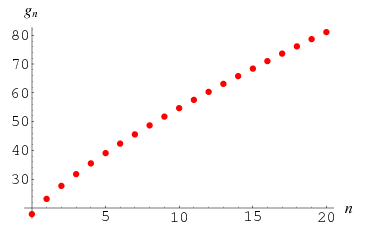
Let  be the Riemann-Siegel function. The unique value
  such that
 |
(1)
|
where  , 1, ... is then known as a Gram point (Edwards 2001, pp. 125-126).
An excellent approximation for Gram point  can be obtained by using the first few terms in the asymptotic expansion for
  and inverting to obtain
![g_n approx 2piexp[1+W((8n+1)/(8e))],](https://mathworld.wolfram.com/images/equations/GramPoint/NumberedEquation2.gif) |
(2)
|
where  is the Lambert W-function. This approximation gives as error of
  for
for  , decreasing to
  by
by  .
.
The following table gives the first few Gram points.
 |
OEIS |
 |
| 0 |
A114857 |
17.8455995404 |
| 1 |
A114858 |
23.1702827012 |
| 2 |
|
27.6701822178 |
| 3 |
|
31.7179799547 |
| 4 |
|
35.4671842971 |
| 5 |
|
38.9992099640 |
| 6 |
|
42.3635503920 |
| 7 |
|
45.5930289815 |
| 8 |
|
48.7107766217 |
| 9 |
|
51.7338428133 |
| 10 |
|
54.6752374468 |
The integers closest to these points are 18, 23, 28, 32, 35, 39, 42, 46, 49, 52, 55, 58, ... (OEIS A002505).
There is a unique point at which  , given by the solution to the equation
 |
(3)
|
and having numerical value
 |
(4)
|
(OEIS A114893).
It is usually the case that ![R[zeta(1/2+ig_n)]=(-1)^nZ(g_n)>0](https://mathworld.wolfram.com/images/equations/GramPoint/Inline14.gif) . Values of
. Values of  for which this does not hold are
  , 134, 195, 211, 232, 254, 288, ... (OEIS A114856), the first two of which were found by Hutchinson (1925).
REFERENCES:
Edwards, H. M. Riemann's Zeta Function. New York: Dover, 2001.
Gram, J.-P. "Sur les zéros de la fonction  de Riemann." Acta Math. 27, 289-304, 1903.
Haselgrove, C. B. and Miller, J. C. P. "Tables of the Riemann Zeta Function." Royal Society Mathematical Tables, Vol. 6. Cambridge, England: Cambridge University Press, p. 58, 1960.
Hutchinson, J. I. "On the Roots of the Riemann Zeta-Function." Trans. Amer. Math. Soc. 27, 49-60, 1925.
Sloane, N. J. A. Sequences A002505/M5052, A114856, A114857, A114858, and A114893 Sloane, N. J. A. Sequences








