Bartlett Function
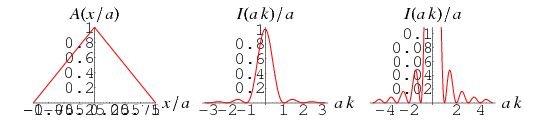
The apodization function
 |
(1)
|
which is a generalization of the one-argument triangle function. Its full width at half maximum is  .
.
It has instrument function
 |
(2)
|
where  is the sinc function. The peak of
  is
is  , and the full width at half maximum is given by setting
  and numerically solving
 |
(3)
|
for  , yielding
 |
(4)
|
Therefore, with  ,
,
 |
(5)
|
The function  is always positive, so there are no negative sidelobes. The extrema are given by differentiating
  with respect to
  , defining
  , and setting equal to 0,
 |
(6)
|
Solving this numerically gives minima of 0 at  , 2, 3, ..., and sidelobes of 0.047190, 0.01648, 0.00834029, ... at
  , 2.45892, 3.47089, ....
REFERENCES:
Bartlett, M. S. "Periodogram Analysis and Continuous Spectra." Biometrika 37, 1-16, 1950.
Blackman, R. B. and Tukey, J. W. The Measurement of Power Spectra, From the Point of View of Communications Engineering. New York: Dover, pp. 98-99, 1959.
Press, W. H.; Flannery, B. P.; Teukolsky, S. A.; and Vetterling, W. T. Numerical Recipes in FORTRAN: The Art of Scientific Computing, 2nd ed. Cambridge, England: Cambridge University Press, pp. 554-556, 1992.








