Ball Triangle Picking
Ball triangle picking is the selection of triples of points (corresponding to vertices of a general triangle) randomly placed inside a ball.  random triangles can be picked in a unit ball in the Wolfram Language using the function RandomPoint[Ball[],
 ![<span style=]() {" src="http://mathworld.wolfram.com/images/equations/BallTrianglePicking/Inline2.gif" style="height:15px; width:5px" />n, 3
{" src="http://mathworld.wolfram.com/images/equations/BallTrianglePicking/Inline2.gif" style="height:15px; width:5px" />n, 3![<span style=]() }" src="http://mathworld.wolfram.com/images/equations/BallTrianglePicking/Inline3.gif" style="height:15px; width:5px" />].
}" src="http://mathworld.wolfram.com/images/equations/BallTrianglePicking/Inline3.gif" style="height:15px; width:5px" />].
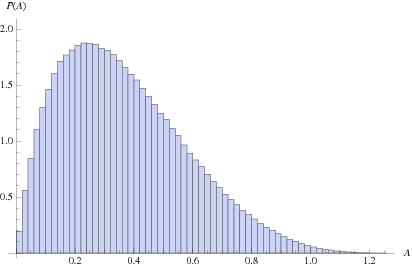
The distribution of areas of a triangle with vertices picked at random in a unit ball is illustrated above. The mean triangle area is
 |
(1)
|
(Buchta and Müller 1984, Finch 2010).
 random triangles can be picked in a unit ball in the Wolfram Language using the function RandomPoint[Ball[],
 ![<span style=]() {" src="http://mathworld.wolfram.com/images/equations/BallTrianglePicking/Inline5.gif" style="height:15px; width:5px" />n, 3
{" src="http://mathworld.wolfram.com/images/equations/BallTrianglePicking/Inline5.gif" style="height:15px; width:5px" />n, 3![<span style=]() }" src="http://mathworld.wolfram.com/images/equations/BallTrianglePicking/Inline6.gif" style="height:15px; width:5px" />].
}" src="http://mathworld.wolfram.com/images/equations/BallTrianglePicking/Inline6.gif" style="height:15px; width:5px" />].
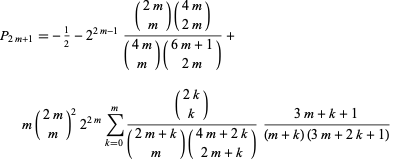
The determination of the probability for obtaining an acute triangle by picking three points at random in the unit disk was generalized by Hall (1982) to the  -dimensional ball. Buchta (1986) subsequently gave closed form evaluations for Hall's integrals. Let
  be the probability that three points chosen independently and uniformly from the
  -ball form an acute triangle, then
 |
(2)
|
![P_(2m+2)=1/4-3/(2^(2m+4))((4m+4; m+1))/((2m+2; m+1))+(2^(4m))/((2m; m)pi^2)[1/((2m+1)^2(2m; m))+sum_(k=0)^(m)(2^(2k)(3m+k-3))/((2k+1)(2k; k)(2m+k; m)(2m+k+2; 2))].](http://mathworld.wolfram.com/images/equations/BallTrianglePicking/Inline11.gif) |
(3)
|
These can be combined and written in the slightly messy closed form
![P_n=pi^(-3/2)<span style=]() {2^(2n-5)(n-1)[Gamma(1/2n)]^4[n_3F^~_2(1,n+1,1/2n+1;1/2(n+3),3/2n+1;1)-2_3F^~_2(1,n,1/2n+1;3/2n,1/2(n+3);1)]
-(sqrt(pi)Gamma(2n))/(4^nGamma(3/2n)Gamma(1/2(n+1)))+1}, " src="http://mathworld.wolfram.com/images/equations/BallTrianglePicking/NumberedEquation2.gif" style="height:109px; width:493px" /> {2^(2n-5)(n-1)[Gamma(1/2n)]^4[n_3F^~_2(1,n+1,1/2n+1;1/2(n+3),3/2n+1;1)-2_3F^~_2(1,n,1/2n+1;3/2n,1/2(n+3);1)]
-(sqrt(pi)Gamma(2n))/(4^nGamma(3/2n)Gamma(1/2(n+1)))+1}, " src="http://mathworld.wolfram.com/images/equations/BallTrianglePicking/NumberedEquation2.gif" style="height:109px; width:493px" /> |
(4)
|
where  is a regularized hypergeometric function.
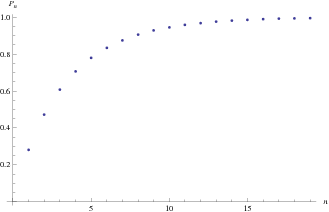
The first few are
(OEIS A093756 and A093757, OEIS A093758 and A093759, and OEIS A093760 and A093761), plotted above.
The case  corresponds to disk triangle picking.
REFERENCES:
Buchta, C. "A Note on the Volume of a Random Polytope in a Tetrahedron." Ill. J. Math. 30, 653-659, 1986.
Buchta, C. and Müller, J. "Random Polytopes in a Ball." J. Appl. Prob. 21, 753-762, 1984.
Finch, S. "Random Triangles III." http://algo.inria.fr/csolve/rtg3.pdf. Apr. 30, 2010.
Hall, G. R. "Acute Triangles in the  -Ball." J. Appl. Prob. 19, 712-715, 1982.
Sloane, N. J. A. Sequences A093756, A093757, A093758, A093759, A093760, and A093761 in "The On-Line Encyclopedia of Integer Sequences."








