Chinese Remainder Theorem
Let  and
and  be positive integers which are relatively prime and let
  and
and  be any two integers. Then there is an integer
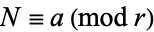
  such that
 |
(1)
|
and
 |
(2)
|
Moreover,  is uniquely determined modulo
  . An equivalent statement is that if
 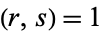 , then every pair of residue classes modulo
  and
and  corresponds to a simple residue class modulo
  .
.
The Chinese remainder theorem is implemented in the Wolfram Language as ChineseRemainder[![<span style=]() {" src="http://mathworld.wolfram.com/images/equations/ChineseRemainderTheorem/Inline12.gif" style="height:15px; width:5px" />a1, a2, ...
{" src="http://mathworld.wolfram.com/images/equations/ChineseRemainderTheorem/Inline12.gif" style="height:15px; width:5px" />a1, a2, ...![<span style=]() }" src="http://mathworld.wolfram.com/images/equations/ChineseRemainderTheorem/Inline13.gif" style="height:15px; width:5px" />
}" src="http://mathworld.wolfram.com/images/equations/ChineseRemainderTheorem/Inline13.gif" style="height:15px; width:5px" />![<span style=]() {" src="http://mathworld.wolfram.com/images/equations/ChineseRemainderTheorem/Inline14.gif" style="height:15px; width:5px" />m1, m2, ...
{" src="http://mathworld.wolfram.com/images/equations/ChineseRemainderTheorem/Inline14.gif" style="height:15px; width:5px" />m1, m2, ...![<span style=]() }" src="http://mathworld.wolfram.com/images/equations/ChineseRemainderTheorem/Inline15.gif" style="height:15px; width:5px" />]. The Chinese remainder theorem is also implemented indirectly using Reduce in with a domain specification of Integers.
}" src="http://mathworld.wolfram.com/images/equations/ChineseRemainderTheorem/Inline15.gif" style="height:15px; width:5px" />]. The Chinese remainder theorem is also implemented indirectly using Reduce in with a domain specification of Integers.
The theorem can also be generalized as follows. Given a set of simultaneous congruences
 |
(3)
|
for  , ...,
  and for which the
  are pairwise relatively prime, the solution of the set of congruences is
 |
(4)
|
where
 |
(5)
|
and the  are determined from
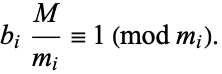 |
(6)
|
REFERENCES:
Flannery, S. and Flannery, D. In Code: A Mathematical Journey. London: Profile Books, pp. 123-125, 2000.
Ireland, K. and Rosen, M. "The Chinese Remainder Theorem." §3.4 in A Classical Introduction to Modern Number Theory, 2nd ed. New York: Springer-Verlag, pp. 34-38, 1990.
Séroul, R. "The Chinese Remainder Theorem." §2.6 in Programming for Mathematicians. Berlin: Springer-Verlag, pp. 12-14, 2000.
Uspensky, J. V. and Heaslet, M. A. Elementary Number Theory. New York: McGraw-Hill, pp. 189-191, 1939.
Wagon, S. "The Chinese Remainder Theorem." §8.4 in Mathematica in Action. New York: W. H. Freeman, pp. 260-263, 1991.








