Pisot Number
A Pisot number is a positive algebraic integer greater than 1 all of whose conjugate elements have absolute value less than 1. A real quadratic algebraic integer greater than 1 and of degree 2 or 3 is a Pisot number if its norm is equal to  . The golden ratio
  (denoted
  when considered as a Pisot number) is an example of a Pisot number since it has degree two and norm
  .
.
The smallest Pisot number is given by the positive root  (OEIS A060006) of
 |
(1)
|
known as the plastic constant. This number was identified as the smallest known by Salem (1944), and proved to be the smallest possible by Siegel (1944).
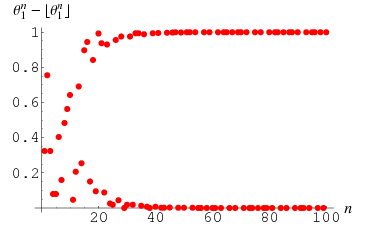
Pisot constants give rise to almost integers. For example, the larger the power to which  is taken, the closer
  , where
  is the floor function, is to either 0 or 1 (Trott 2004). For example, the spectacular example
  is within
  of an integer (Trott 2004, pp. 8-9).
The powers of  for which this quantity is closer to 0 are 1, 3, 4, 5, 6, 7, 8, 11, 12, 14, 17, ... (OEIS A051016), while those for which it is closer to 1 are 2, 9, 10, 13, 15, 16, 18, 20, 21, 23, ... (OEIS A051017).
Siegel also identified the second smallest Pisot numbers as the positive root  (OEIS A086106) of
 |
(2)
|
showed that  and
and  are isolated, and showed that the positive roots of each polynomial
 |
(3)
|
for  , 2, 3, ...,
 |
(4)
|
for  , 5, 7, ..., and
 |
(5)
|
for  , 5, 7, ... are Pisot numbers.
All the Pisot numbers less than  are known (Dufresnoy and Pisot 1955). Some small Pisot numbers and their polynomials are given in the following table. The latter two entries are from Boyd (1977).
| number |
Sloane |
order |
polynomial coefficients |
| 1.3247179572 |
A060006 |
3 |
1 0   |
| 1.3802775691 |
A086106 |
4 |
1  0 0 0 0  |
| 1.6216584885 |
|
16 |
1  2 2  2 2  1 0 0 1 1 0 0 1  2 2  2 2  1 1  |
| 1.8374664495 |
|
20 |
1  0 1 0 1  0 1 0 1  0 1 0 0 1 0  0 1 0 1  0 1 0 1  0 1 0 1  |
Pisot numbers originally arose in the consideration of
 |
(6)
|
where  denotes the fractional part of
  and
and  is the floor function. Letting
  be a number greater than 1 and
  a positive number, for a given
  , the sequence of numbers
  for
for  , 2, ... is an equidistributed sequence in the interval (0, 1) when
  does not belong to a
  -dependent exceptional set
  of measure zero (Koksma 1935). Pisot (1938) and Vijayaraghavan (1941) independently studied the exceptional values of
  , and Salem (1943) proposed calling such values Pisot-Vijayaraghavan numbers.
Pisot (1938) subsequently proved the fact that if  is chosen such that there exists a
  for which the series
 |
(7)
|
converges, then  is an algebraic integer whose conjugates all (except for itself) have modulus
  , and
, and  is an algebraic integer of the field
  . Vijayaraghavan (1940) proved that the set of Pisot numbers has infinitely many limit points. Salem (1944) proved that the set of Pisot numbers is closed. The proof of this theorem is based on the lemma that for a Pisot number
  , there always exists a number
  such that
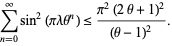
  and the following inequality is satisfied:
 |
(8)
|
REFERENCES:
Bell, J. P. and Hare, K. G. "Properties of  for
for  a Pisot number." http://www.math.uwaterloo.ca/~kghare/Preprints/PDF/P17_Zq.pdf.
Bertin, M. J. and Pathiaux-Delefosse, A. Conjecture de Lehmer et petits nombres de Salem. Kingston: Queen's Papers in Pure and Applied Mathematics, 1989.
Bertin, M. J.; Decomps-Guilloux, A.; Grandet-Hugot, M.; Pathiaux-Delefosse, M.; and Schreiber, J. P. Pisot and Salem Numbers. Basel: Birkhäuser, 1992.
Borwein, P. and Hare, K. G. "Some Computations on Pisot and Salem Numbers." CECM-00:148, 18 May. http://www.cecm.sfu.ca/preprints/2000pp.html#00:148.
Boyd, D. W. "Small Salem Numbers." Duke Math. J. 44, 315-328, 1977.
Boyd, D. W. "Pisot and Salem Numbers in Intervals of the Real Line." Math. Comput. 32, 1244-1260, 1978.
Boyd, D. W. "Pisot Numbers in the Neighbourhood of a Limit Point. II." Math. Comput. 43, 593-602, 1984.
Boyd, D. W. "Pisot Numbers in the Neighbourhood of a Limit Point. I." J. Number Theory 21, 17-43, 1985.
Dubickas, A. "A Note on Powers of Pisot Numbers." Publ. Math. Debrecen 56, 141-144, 2000.
Dufresnoy, J. and Pisot, C. "Étude de certaines fonctions méromorphes bornées sur le cercle unité, application à un ensemble fermé d'entiers algébriques." Ann. Sci. École Norm. Sup. 72, 69-92, 1955.
Erdős, P.; Joó, M.; and Schnitzer, F. J. "On Pisot Numbers." Ann. Univ. Sci. Budapest, Eőtvős Sect. Math. 39, 95-99, 1997.
Katai, I. and Kovacs, B. "Multiplicative Functions with Nearly Integer Values." Acta Sci. Math. 48, 221-225, 1985.
Koksma, J. F. "Ein mengentheoretischer Satz über die Gleichverteilung modulo Eins." Comp. Math. 2, 250-258, 1935.
Le Lionnais, F. Les nombres remarquables. Paris: Hermann, pp. 38 and 148, 1983.
Luca, F. "On a Question of G. Kuba." Arch. Math. (Basel) 74, 269-275, 2000.
Pisot, C. "La répartition modulo 1 et les nombres algébriques." Annali di Pisa 7, 205-248, 1938.
Salem, R. "Sets of Uniqueness and Sets of Multiplicity." Trans. Amer. Math. Soc. 54, 218-228, 1943.
Salem, R. "A Remarkable Class of Algebraic Numbers. Proof of a Conjecture of Vijayaraghavan." Duke Math. J. 11, 103-108, 1944.
Salem, R. "Power Series with Integral Coefficients." Duke Math. J. 12, 153-172, 1945.
Siegel, C. L. "Algebraic Numbers whose Conjugates Lie in the Unit Circle." Duke Math. J. 11, 597-602, 1944.
Sloane, N. J. A. Sequences A051016, A051017, A060006, and A086106 in "The On-Line Encyclopedia of Integer Sequences."
Trott, M. The Mathematica GuideBook for Programming. New York: Springer-Verlag, 2004. http://www.mathematicaguidebooks.org/.
Vijayaraghavan, T. "On the Fractional Parts of the Powers of a Number, II." Proc. Cambridge Phil. Soc. 37, 349-357, 1941.








